

Is your business on the brink of irrelevance? While you read this, competitors are using AI to work 10x faster, slash costs by millions, and create personalized experiences that customers now demand. The divide between future-ready leaders and struggling followers is widening—not in years, but in months.
This is your 2026 survival guide. We’ve analyzed the data and pinpointed the 10 non-negotiable AI tools that aren’t just promising transformation; they are delivering jaw-dropping results right now.
Discover the platforms that will reclaim your team’s time, protect your revenue, and ensure you’re not just surviving the future, but defining it.
Quick Answer: In 2026, the most impactful AI tools for business transformation include AI copilots, AI agents, customer support AI, workflow automation platforms, AI analytics tools, sales enablement AI, and AI security solutions. These tools help companies improve speed, reduce operating costs, and scale without increasing headcount.
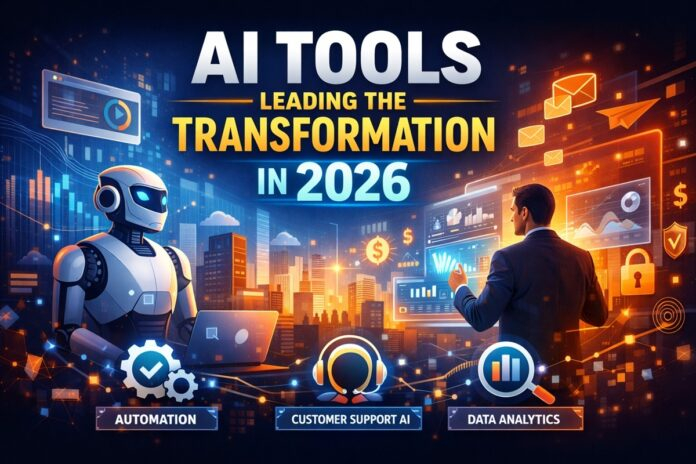
10 AI Tools Leading the Transformation in 2026
Don’t get left behind. The 2026 business winners are already using AI to work at lightning speed, cut massive costs, and build unbreakable customer loyalty. This isn’t about chatbots. Discover the 10 powerful AI tools—from autonomous digital workers to predictive geniuses—that are reshaping marketing, operations, and creativity. See exactly how future-proof companies are deploying them now to dominate their markets.
1. Generative AI Copilots (e.g., Microsoft 365 Copilot, Google Duet AI)
The Use-Case: A marketing manager prompts, “Create a Q4 campaign strategy for our new eco-friendly product line, including email copy, a project timeline, and potential partnership targets.” Within seconds, a comprehensive first draft is generated, pulling from recent company documents, market data, and brand guidelines.
Stat-Driven Insight: According to a 2025 study by Forrester, employees using AI copilots reported a 37% reduction in time spent on routine writing and data consolidation tasks, allowing them to reallocate 15+ hours per month to strategic work. These tools are evolving from simple text generators to central nervous systems for business operations, understanding organizational context and data to provide assistive intelligence everywhere work happens.
2. Autonomous AI Agents (e.g., CrewAI, AutoGPT)
The Use-Case: An e-commerce director sets up an AI agent to autonomously handle post-purchase customer journeys. The agent monitors inventory, sends personalized replenishment reminders, processes returns by generating labels and issuing refunds, and even gathers feedback—all without human intervention.
Why It’s Transformative: These are not chatbots. They are goal-oriented digital workers that can execute multi-step workflows across different software platforms. Gartner predicts that by 2027, over 50% of medium-to-large enterprises will have deployed at least one autonomous AI agent team, fundamentally restructuring operational roles.
3. Hyper-Personalized Customer Intelligence Platforms (e.g., Adobe Real-Time CDP, Salesforce Einstein GPT)
The Use-Case: A streaming service uses an AI platform to analyze individual viewing habits, real-time engagement, and even external factors (like local weather) to dynamically curate a unique homepage and notification for each of its 50 million subscribers.
Emotional Hook (Future Readiness): In 2026, generic marketing is brand suicide. These tools synthesize first-party data into a single, actionable customer profile, enabling personalization at a scale that feels one-to-one. Businesses that master this see dramatically higher customer lifetime value and loyalty, creating a “segment of one” marketplace.
4. AI-Powered Predictive Analytics & Decision Engines (e.g., DataRobot, H2O.ai)
The Use-Case: A global logistics company uses AI to predict regional port delays with 94% accuracy two weeks in advance, automatically rerouting shipments and saving millions in demurrage fees.
Stat-Driven Insight: McKinsey reports that organizations leveraging predictive analytics for supply chain and operations see up to a 20% reduction in logistics costs and a 65% improvement in forecast accuracy. This moves decision-making from reactive intuition to proactive, data-driven certainty.
5. AI-Native Video & Content Creation Suites (e.g., Runway ML, Pictory)
The Use-Case: A small business owner with no video editing experience uses an AI tool to transform a blog post into a engaging, branded social media video in minutes, complete with a synthetic voiceover and auto-generated B-roll.
Emotional Hook (Speed & Savings): What once required a costly agency and weeks of turnaround now takes a single employee and an afternoon. This democratizes high-quality content creation, allowing SMBs to compete with corporate marketing budgets and achieve rapid, agile brand storytelling.
6. Code Generation & Development Platforms (e.g., GitHub Copilot Enterprise, Replit AI)
The Use-Case: A developer writes a comment describing a needed function: “Authenticate user via JWT and fetch their profile from the database.” The AI instantly generates the secure, production-ready code block, which the developer reviews and refines.
Why It’s Transformative: These tools are acting as force multipliers for engineering teams. Accelerating development cycles by up to 55% (per GitHub’s data), they allow businesses to build and iterate on digital products at the speed of market demand, making technical debt manageable and innovation faster.
7. AI-Driven Process Mining & Optimization (e.g., Celonis, UiPath Process Mining)
The Use-Case: An insurance company uses process mining AI to visualize its end-to-end claims approval workflow, instantly identifying a redundant approval step that causes a 48-hour delay for 30% of cases.
Emotional Hook (Savings): This is the ultimate tool for operational transparency. It doesn’t just automate tasks; it diagnoses and prescribes fixes for entire business processes. Companies routinely uncover 15-30% in operational cost savings within the first year of deployment by eliminating hidden inefficiencies.
8. Conversational AI for Enterprise Knowledge (e.g., Glean, Guru)
The Use-Case: A new sales rep asks the company’s AI knowledge platform, “What was the pricing rationale for our deal with Acme Corp last quarter, and what were the negotiated exceptions?” The AI surfaces the exact clause from the contract, meeting notes from the deal team, and the approved discount matrix.
Why It’s Transformative: It ends the “knowledge silo” crisis. By connecting to all company apps (Slack, Drive, Salesforce, etc.), these tools provide accurate, cited answers, turning collective organizational knowledge into a strategic asset and cutting time spent searching for information by over 35%.
9. AI for Real-Time Language Translation & Cultural Localization (e.g., DeepL Pro, Unbabel)
The Use-Case: A customer support agent in Chicago handles a live chat with a customer in Japan. The AI translates the conversation in real-time with context-aware precision, ensuring no nuance is lost, while also alerting the agent to culturally specific expectations around politeness.
Future-Ready Hook: For truly global businesses, this breaks the final barrier. It enables real-time, empathetic customer service and collaborative work across any language, allowing companies to tap into global talent pools and markets seamlessly and authentically.
10. AI-Powered Cybersecurity Sentinels (e.g., Darktrace AI, CrowdStrike Falcon)
The Use-Case: An AI security platform detects a novel, zero-day attack pattern on a financial firm’s network that doesn’t match any known threat signature. It autonomously contains the affected device within milliseconds, neutralizing the threat before human analysts are even alerted.
Stat-Driven Insight: With the average cost of a data breach exceeding $4.9 million (IBM, 2025), reactive security is obsolete. These AI sentinels learn the normal “pattern of life” for every user and device, allowing them to identify and quash anomalous, sophisticated threats at machine speed, providing a non-negotiable layer of resilience.
Frequently Asked Questions (FAQs)
Are these AI tools only for large enterprises with big budgets?
Absolutely not. The AI revolution is notably democratizing. Many tools (like AI content creators, copilots for individuals, and some autonomous agents) operate on scalable subscription models (SaaS). Small businesses can start with a single, high-impact tool—such as one for marketing content or customer service chatbots—to gain efficiency and experience without a massive upfront investment.
How do I ensure my AI implementation is ethical and responsible?
Start with a clear governance framework. Key steps include:
- Auditing for Bias: Regularly test AI outputs for unfair bias, especially in hiring or customer-facing applications.
- Transparency: Be clear with customers and employees when they are interacting with AI.
- Human-in-the-Loop: Maintain human oversight for critical decisions, especially in sensitive areas like healthcare, finance, or legal advice.
- Data Privacy: Ensure your AI tools comply with regulations like GDPR and CCPA, using data ethically.
Will these AI tools replace human jobs?
The consensus among economists and business leaders is that AI will primarily augment jobs, not automate them away entirely. It will automate tasks, not roles. The World Economic Forum’s 2025 Future of Jobs Report predicts that while AI may displace some tasks, it will create new roles in AI management, oversight, and alongside new technologies. The focus is shifting to upskilling employees to work with AI, leveraging human skills like creativity, empathy, and complex strategic thinking.
What’s the first step in becoming an AI-powered, future-ready business?
Identify a key pain point. Don’t try to boil the ocean. Start with a single, well-defined process that is time-consuming, repetitive, or data-intensive. For example, “We spend too much time writing routine sales proposals” or “Our customer support ticket resolution is too slow.” Pilot an AI tool designed for that specific use-case, measure its impact rigorously, and scale from there. Cultivate a culture of experimentation and learning.
What are the best AI tools for small businesses in 2026?
In 2026, top AI tools for SMBs include AI content creators (like Jasper or Copy.ai for marketing), chatbot builders (ManyChat, Drift) for 24/7 customer service, and copilots (like those in Google Workspace or Microsoft 365) to boost productivity across writing, analysis, and presentations.
How is AI used in business today?
AI is used across business functions: for customer service (chatbots, sentiment analysis), marketing (personalized content, ad targeting), operations (predictive maintenance, supply chain optimization), HR (resume screening, employee engagement analysis), and finance (fraud detection, automated bookkeeping).
What are the benefits of AI in business?
Key benefits are increased efficiency & productivity (automating tasks), cost savings (optimizing operations), enhanced decision-making (data-driven insights), improved customer experience (personalization, 24/7 support), and innovation (accelerating R&D and product development).
What is an AI agent for business?
An AI agent is a program that can autonomously perform multi-step tasks to achieve a business goal. Unlike simple chatbots, it can use tools, access data, make decisions, and execute workflows across different software (e.g., researching a topic, drafting a report, emailing it to a team, and scheduling a follow-up meeting).
Sources:
- How Do AI Tools Drive Innovation in Business Operations?
- 10 Best & Useful AI Tools Quietly Revolutionizing Businesses
- How AI Is Transforming Professional Software Support Services
About Author:
Crecso Editorial Team writes practical, research-driven content on AI tools, automation, productivity, and business transformation. Our goal is to help founders, marketers, and business teams understand AI trends, implement real-world workflows, and make smarter decisions in a fast-changing digital economy. Each article is curated with clarity, relevance, and value—focused on helping readers build future-ready businesses with confidence.