


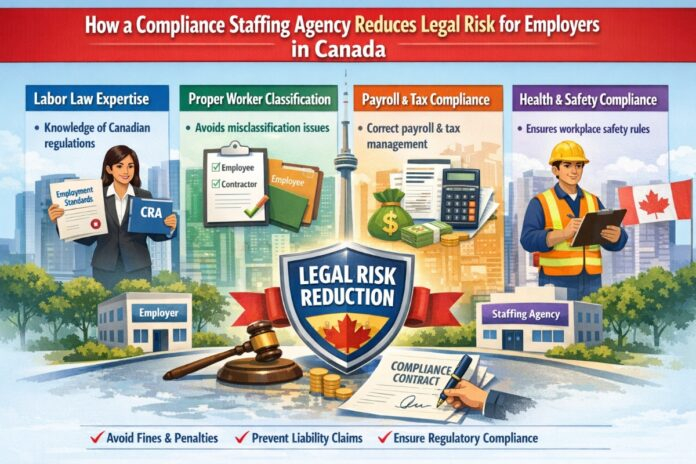
Canadian businesses lose millions each year to fines, back pay orders, and legal disputes caused by employment compliance mistakes. This is why working with a Compliance Staffing Agency Canada has become critical, not optional.
According to a 2023 survey by the Canadian Federation of Independent Business, small and medium sized companies spend between $10,000 and $20,000 annually on regulatory compliance, with workforce related issues among the most expensive risks.
From Employment Standards Acts and CRA payroll rules to WSIB coverage and IRCC immigration compliance, managing everything internally can expose growing companies to serious financial and legal consequences. A specialized compliance staffing partner helps businesses stay compliant, reduce risk, and focus on growth with confidence.
That’s precisely where a Compliance Staffing Agency Canada comes in. By embedding legal, regulatory, and HR expertise directly into your workforce strategy, a compliance-first staffing partner transforms a minefield of obligations into a manageable, auditable process.
This article explores every major legal risk area Canadian employers face and explains exactly how a compliance staffing agency mitigates each one.
1. Worker Classification: The Most Costly Mistake in Canadian Employment Law
Misclassifying employees as independent contractors is the single most common — and most expensive — employment law error in Canada. When a company classifies a worker as a contractor to avoid payroll taxes, EI premiums, and CPP contributions, it exposes itself to substantial CRA reassessments, interest charges, and penalties that can span multiple tax years.
CRA’s Employee vs. Contractor Test
The Canada Revenue Agency applies a four-part test rooted in case law to determine true employment status: control over work, ownership of tools, chance of profit or risk of loss, and the degree of integration into the business. Failing this test retroactively means remitting unpaid employer contributions — plus penalties — for every year the misclassification occurred.
How a Compliance Staffing Agency Helps
A specialist compliance staffing agency conducts thorough worker classification audits before any engagement begins. They maintain up-to-date knowledge of CRA guidelines and provincial labour board interpretations, ensuring every worker is correctly designated from day one. This protects employers from retroactive tax liabilities and shields them in the event of a CRA audit.
2. Payroll Compliance: Navigating CRA Obligations Without Error
Canada’s payroll regime is multi-layered. Employers must correctly calculate and remit source deductions for federal and provincial income tax, Canada Pension Plan (CPP) contributions, and Employment Insurance (EI) premiums — all on strict schedules determined by the CRA. Missing a remittance deadline triggers penalties starting at 3% and climbing to 10% of the outstanding amount, with daily interest accruing on unpaid balances.
Common Payroll Pitfalls for Canadian Employers
- Incorrect remittance frequency (monthly vs. accelerated threshold)
- Failure to remit vacation pay, statutory holiday pay, or overtime correctly
- Non-compliance with T4, T4A, and Record of Employment (ROE) filing deadlines
- Missing obligations for Quebec-based employees under Revenu Québec rules
The Agency Advantage
A compliance staffing agency either manages payroll directly through an Employer of Record (EOR) model or provides validated payroll frameworks your team can implement. Either way, they ensure your remittances are accurate, your records are audit-ready, and your employees receive compliant pay stubs — eliminating one of the most common triggers for CRA scrutiny.
3. Provincial Employment Standards: One Country, Thirteen Different Rulebooks
Canada does not have a single national employment standard. Each province and territory maintains its own Employment Standards Act (ESA) or equivalent legislation — and the differences are material. Minimum wage rates, overtime thresholds, termination notice periods, vacation entitlements, parental leave provisions, and stat holiday rules all vary dramatically from British Columbia to Ontario to Nova Scotia.
A Snapshot of Key Provincial Differences
- Ontario ESA: Overtime after 44 hours per week; minimum 1 week notice per year of service (up to 8 weeks)
- British Columbia Employment Standards Act: Overtime after 8 hours/day or 40 hours/week; double time after 12 hours/day
- Quebec Act Respecting Labour Standards: Managed separately under CNESST; distinct rules for paid leave and dismissal
- Alberta Employment Standards Code: No statutory requirement for paid sick days as of 2024; distinct shift scheduling rules
For employers operating across multiple provinces — or for staffing agencies placing workers in various locations — maintaining compliance with each jurisdiction simultaneously is a massive undertaking.
How a Compliance Staffing Agency Manages This
Top-tier compliance staffing agencies in Canada maintain province-specific employment standards matrices, updated in real time as legislation changes. When they place a worker, they apply the ESA of the province where the work is performed, not the employer’s home province. This granular, jurisdiction-aware approach prevents the inadvertent violations that occur when companies apply a single national policy to a geographically dispersed workforce.
4. Workplace Safety Compliance: WSIB and Provincial OHS Obligations
Every Canadian employer has obligations under their provincial Occupational Health and Safety (OHS) legislation, and most are required to register with their provincial workers’ compensation board — the most well-known being Ontario’s Workplace Safety and Insurance Board (WSIB). Failure to register, underreport payroll, or maintain a safe workplace can result in significant surcharges, premium increases, stop-work orders, and even personal liability for corporate officers.
Key Obligations Managed by a Compliance Staffing Agency
- Correct WSIB rate classification by industry code (NAICS)
- Accurate payroll reporting to avoid premium under- or over-payment
- Return-to-work program administration for injured workers
- OHS policy documentation, training records, and Joint Health and Safety Committee requirements
In high-risk sectors such as construction, manufacturing, and healthcare, these obligations carry additional weight. A compliance staffing agency with sector expertise ensures that every placed worker is covered correctly, reducing both financial exposure and the risk of stop-work orders that halt operations.
5. Immigration Compliance: Meeting IRCC and ESDC Requirements
Canadian employers hiring temporary foreign workers (TFWs) or international students must navigate a complex web of federal immigration rules managed by Immigration, Refugees and Citizenship Canada (IRCC) and Employment and Social Development Canada (ESDC). Non-compliance with the Temporary Foreign Worker Program (TFWP) or the International Mobility Program (IMP) can result in bans from hiring foreign nationals for up to two years — a devastating consequence for industries that depend on international talent.
Common Immigration Compliance Failures
- Failing to maintain required records for ESDC compliance inspections
- Not honouring wage and working condition commitments made in Labour Market Impact Assessments (LMIAs)
- Employing workers beyond their authorized work permit conditions
- Neglecting to track permit expiry dates and initiate renewals proactively
The Compliance Agency’s Role
A compliance staffing agency with immigration expertise tracks permit conditions, flags upcoming expiries, and ensures that job duties, wages, and worksite locations remain consistent with what was approved by IRCC. For employers in healthcare, agriculture, and tech — sectors with high TFW utilization — this oversight is not a luxury; it is an operational necessity.
6. Industry-Specific Regulatory Obligations
Beyond general employment law, many Canadian industries are subject to sector-specific regulations that add another compliance layer. A compliance staffing agency with deep vertical expertise ensures these obligations are met without additional burden on the employer’s HR team.
Healthcare
Staffing in Ontario’s healthcare sector requires adherence to the Fixing Long-Term Care Act, limits on agency rates set by provincial health authorities, credential verification requirements, and vulnerable-sector screening obligations under the Criminal Code.
Construction
Construction employers must comply with provincial Construction Lien Acts, union collective agreements where applicable, mandatory safety training certifications (e.g., Working at Heights in Ontario), and specific WSIB rate classifications that vary by trade.
Federally Regulated Industries
Banking, telecommunications, interprovincial transport, and broadcasting fall under federal jurisdiction — governed by the Canada Labour Code rather than provincial ESAs. Employers in these sectors face distinct overtime rules, unjust dismissal protections, and union relations obligations that require specialized knowledge.
7. The Employer of Record Model: Transferring Legal Liability
One of the most powerful tools offered by a compliance staffing agency is the Employer of Record (EOR) arrangement. Under this model, the staffing agency becomes the legal employer of record for workers placed with client businesses. The agency handles all employment law obligations — payroll, benefits, source deductions, ESA compliance, WSIB registration — while the client directs the day-to-day work.
Why Canadian Companies Are Embracing the EOR Model
- Eliminates the need to establish a legal entity in every province of operation
- Transfers employer-of-record liability for employment standards violations to the agency
- Accelerates hiring timelines by removing administrative setup delays
- Provides complete payroll and HR compliance out of the box
- Ideal for project-based, remote, or cross-provincial engagements
For startups scaling rapidly, enterprises entering new Canadian markets, and international companies with Canadian operations, the EOR model offered by a compliance staffing agency can compress months of legal and HR setup into days — without sacrificing compliance integrity.
8. The Financial Impact of Non-Compliance: Why the Risk Is Too High to Ignore
The consequences of employment law non-compliance in Canada are not theoretical. They are quantifiable, public, and increasingly pursued by regulators who have expanded their enforcement powers in recent years.
Real-World Penalties Canadian Employers Face
- CRA payroll violations: Penalties of 10% of unremitted amounts plus daily interest; potential director liability for corporate officers
- ESA violations (Ontario): Orders to pay up to $10,000 per violation; compliance orders; reputational damage from public posting
- WSIB non-compliance: Premium surcharges, stop-work orders, and personal liability for business owners
- IRCC/ESDC violations: Two-year bans from hiring TFWs; public listing on the non-compliant employers registry
- Wrongful dismissal: Damage awards in provincial courts that regularly exceed statutory minimums when proper procedures are not followed
Beyond direct fines, the indirect costs — legal fees, HR management time, productivity loss, and reputational damage with candidates and clients — often exceed the penalties themselves. A compliance staffing agency is not an expense; it is insurance against costs that can reach six figures or more per incident.
Conclusion: Compliance Is a Competitive Advantage
For Canadian employers, employment compliance is no longer purely a legal obligation — it is a strategic imperative. In an era of heightened regulatory scrutiny, cross-provincial workforces, and increasingly mobile talent, the risks of managing compliance internally without specialist support are significant and growing.
A Compliance Staffing Agency Canada partner brings the expertise, systems, and legal infrastructure needed to ensure every worker engagement is built on a solid regulatory foundation. From CRA payroll accuracy and provincial ESA adherence to WSIB registration and IRCC compliance, these agencies reduce legal exposure, protect employer brand, and free HR and finance teams to focus on strategic priorities rather than regulatory firefighting.
If your business is growing, operating across provinces, hiring internationally, or simply not certain that your current HR practices would survive a government audit, partnering with a compliance staffing agency is one of the highest-return investments you can make in your workforce strategy.
Frequently Asked Questions (FAQs)
What is a Compliance Staffing Agency in Canada, and how is it different from a regular staffing agency?
A compliance staffing agency specializes not only in sourcing and placing workers but in ensuring every aspect of the employment relationship meets Canadian federal and provincial legal requirements. Unlike general staffing firms, a compliance-focused agency maintains deep expertise in CRA payroll rules, provincial Employment Standards Acts, WSIB obligations, and IRCC immigration compliance — and builds these into every client engagement by design, not as an afterthought.
Can a compliance staffing agency help if my business operates in multiple Canadian provinces?
Yes — this is one of the core value propositions of a multi-jurisdictional compliance staffing agency. They maintain up-to-date knowledge of every provincial ESA, apply the correct jurisdiction’s rules to each worker based on where the work is performed, and manage the complexity of cross-provincial payroll, benefits, and workplace safety obligations on your behalf.
What is an Employer of Record (EOR), and does a compliance staffing agency offer this service?
An Employer of Record (EOR) is a third-party organization that legally employs workers on behalf of a client company, taking on all employer responsibilities including payroll processing, source deductions, ESA compliance, and WSIB registration. Many compliance staffing agencies in Canada offer EOR services, making them an ideal solution for businesses that want to engage workers in new provinces or internationally without establishing a separate legal entity.
How does a compliance staffing agency help with CRA audits?
A compliance staffing agency ensures your worker classifications, payroll records, and remittance histories are accurate and audit-ready from the outset. In the event of a CRA audit, they can provide documentation supporting proper employee vs. contractor designations, correct remittance histories, and evidence of compliant payroll practices — dramatically reducing your audit risk and exposure.
Is using a compliance staffing agency cost-effective for small and medium-sized Canadian businesses?
For most SMBs, the cost of a compliance staffing agency is substantially lower than the cost of a single regulatory violation. When you factor in CRA penalties, provincial ESA fines, WSIB surcharges, and the legal fees associated with defending a non-compliance matter, the investment in specialist compliance support pays for itself many times over. Many agencies also offer scalable service models that align with the size and complexity of your workforce.
About the Author
Sandeep Dharak | Content Marketer, Compliance Staffing Agency Canada
Sandeep Dharak is a content marketer and B2B writer specializing in Canadian employment law, workforce compliance, and HR strategy. At Compliance Staffing Agency Canada, Sandeep helps employers navigate the regulatory complexities of the Canadian labour market through clear, research-driven content. His work translates complex legal obligations — from CRA payroll rules to provincial ESA requirements — into actionable guidance that helps HR leaders and business owners protect their organizations and build compliant, high-performing teams.
Disclaimer: This article is for informational purposes only and does not constitute legal advice. Employers should consult a qualified employment lawyer or compliance specialist for guidance specific to their situation.