

If you’ve spent any time in the SEO world, you’ve heard one thing repeated over and over: backlinks matter. And despite every algorithm update Google has rolled out over the past decade, that statement has never stopped being true.
But here’s the thing most people miss — not all backlinks are created equal. A link from a trusted, authoritative website in your niche is worth exponentially more than dozens of links from low-quality directories or irrelevant blogs. That gap in quality is exactly why authority guest posting has become one of the most effective white hat link building strategies available today.
In this guide, we’re going to break down everything: what authority backlinks are, why Google trusts editorial links more than manufactured ones, and how a genuine authority guest posting strategy can sustainably improve your search rankings.
What Are Authority Backlinks and Why Do They Matter?
Authority backlinks are inbound links that come from websites Google already considers credible, trustworthy, and relevant. Think of established industry publications, respected niche blogs, news portals, and educational or professional resource sites — websites that have earned their reputation by consistently publishing high-quality content over time.
Google’s algorithm uses backlinks as a form of endorsement. When Site A links to Site B, it’s essentially saying, “I trust this content enough to send my readers there.” But the value of that endorsement depends entirely on the credibility of Site A.
A link from a high-authority news site or a respected industry journal sends a strong trust signal to Google. A link from a site with no traffic, thin content, or a sketchy link profile sends almost no signal at all — and in some cases, it can actively hurt you.
That’s why businesses that focus on building high authority backlinks rather than chasing volume tend to see more stable, long-term ranking improvements.
Why Google Trusts Editorial Backlinks More Than Artificial Links
Here’s a distinction that’s easy to overlook but absolutely critical: editorial backlinks are links that are given organically because your content genuinely deserves to be referenced. They’re contextual, relevant, and earned.
Artificial links, on the other hand, are placed purely for SEO purposes — private blog networks (PBNs), link farms, paid link schemes, or low-effort directory submissions. Google has gotten remarkably good at identifying these patterns, and it penalizes sites that rely on them.
Editorial links tend to have a few things in common:
- They appear within the body of a well-written, substantive article
- They’re surrounded by relevant content that contextually supports the link
- They come from websites that apply editorial standards before publishing
- They’re placed because they add genuine value to the reader
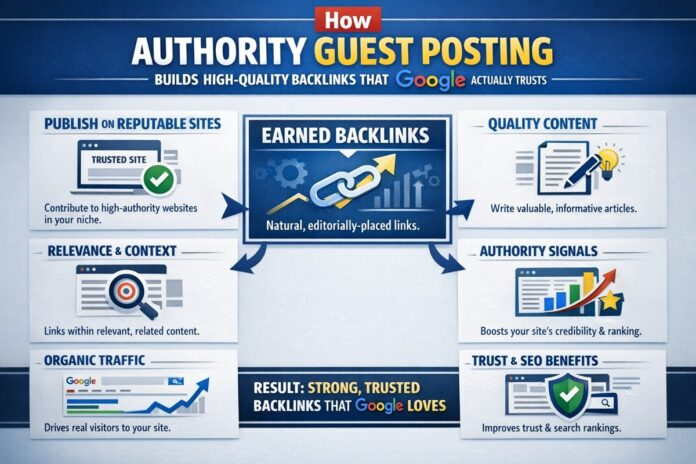
This is precisely why authority guest posting — when done properly — aligns so well with what Google actually rewards. A guest article placed on a trusted website, reviewed by real editors, and published within a relevant context is as close to a genuine editorial link as you can get through an outreach-driven process.
Low-Quality Guest Posting vs. Authority Guest Posting
Not all guest posting is equal, and this is where a lot of businesses get burned.
Low-quality guest posting typically involves:
- Submitting generic articles to any site that accepts guest posts
- Targeting websites with inflated DA metrics but no real traffic or audience
- Using the same anchor text across dozens of placements
- Working with networks of sites that exist purely to sell links
This approach might look good on a spreadsheet, but it doesn’t fool Google. Sites that engage in link schemes eventually see their rankings plateau — or worse, drop after a manual penalty.
Authority guest posting, by contrast, is a research-intensive, relationship-driven process. It means identifying websites that genuinely hold authority in your niche, crafting original content that meets their editorial standards, and earning a placement that serves both their readers and your SEO goals.
The difference comes down to intent. Are you trying to game the system, or are you trying to build a genuine presence on credible platforms?
Why High-Authority Websites Pass Stronger SEO Value
Not all domain authority metrics are created equal, but the underlying principle is sound: websites with stronger link profiles, more organic traffic, and longer editorial histories pass more SEO value through their outbound links.
This concept is sometimes called “link equity” or “PageRank flow.” When a high-authority site links to yours, a portion of its trust and credibility flows into your domain. The more authoritative the source, the stronger that signal.
This is why one well-placed link from a legitimate DR 70+ industry publication can outperform fifty links from low-quality blogs. It’s quality over quantity — always.
How Niche Relevance Affects Backlink Quality
Authority alone isn’t enough. Google also evaluates the topical relevance of the linking site.
A link from a high-authority finance website pointing to a law firm’s article about estate planning is much more valuable than a link from a high-authority technology blog pointing to the same article. The closer the thematic connection, the stronger the trust signal.
This is why niche relevant backlinks are such a priority in modern SEO strategy. When you get placements on websites that cover the same topics your site covers, you’re not just getting a link — you’re getting a contextual endorsement that reinforces your topical authority in Google’s eyes.
The Role of Editorial Review in Link Trust
One of the hallmarks of a legitimate authority guest posting placement is that it goes through real editorial review. When a website has editors who evaluate content quality, check for accuracy, and ensure the link adds value to the article — that link comes with an implicit stamp of approval.
Google understands this. Sites that maintain editorial standards tend to be more trustworthy, and links from those sites are weighted accordingly. This is part of why links from major publications carry so much more weight than links from sites that publish anything without review.
When you pursue guest posting for SEO through a rigorous editorial process, you’re producing something that genuinely earns its place — which is exactly the kind of link Google’s algorithm is designed to reward.
Why Contextual Backlinks Are More Powerful
Contextual backlinks are links placed naturally within the body of a relevant, informative article — not in a footer, sidebar, or author bio. They’re surrounded by related text that reinforces their relevance, and they’re formatted in a way that reads naturally to both humans and search engines.
This context matters enormously. A link embedded within a paragraph explaining a concept, pointing to a resource that expands on that concept, carries far more weight than a bare link buried in a resource list or a navigation menu.
Authority guest posting is one of the best ways to earn true contextual backlinks. Because the content is written specifically for publication on a relevant site, the link naturally fits within the narrative of the article.
The Real Process Behind Authority Guest Posting
A lot of services claim to do authority guest posting. Very few do it properly. Here’s what a legitimate process actually looks like:
1. Discovery and Strategy
Before a single outreach email is sent, the strategy needs to be defined. Which topics should the content cover? What anchor text variations make sense? What’s the target domain authority range? What industries or niches are most relevant to the site being linked to?
2. Publisher Research
This is where most shortcuts happen — and where the quality gap becomes obvious. Legitimate publisher research involves manually vetting sites for real organic traffic, genuine editorial standards, domain history, audience relevance, and link profile health. Metrics alone aren’t enough.
3. Personalized Outreach
Mass outreach to generic “write for us” pages produces generic results. Real guest posting outreach involves personalized pitches, relationship building, and demonstrating genuine familiarity with the target publication’s content and audience.
4. Content Creation
The article needs to be genuinely good — well-researched, original, and valuable to the publication’s readers. It should meet or exceed the quality of the content already on that site. This is not the place for thin, AI-generated filler content.
5. Editorial Approval
A legitimate placement goes through the publisher’s editorial process. This may include revisions, fact-checking, or formatting adjustments. If a site publishes without any review, that’s a red flag.
6. Link Placement
The link should be embedded naturally within the article, contextually relevant to the surrounding text, and pointed to a page on your site that genuinely adds value for the reader.
Why Most Guest Posting Services Fail to Build Real Authority Backlinks
Here’s an uncomfortable truth: the majority of guest posting services in the market are not building real authority backlinks. They’re operating link networks dressed up to look like real publications.
The signs are usually there if you know what to look for:
- Sites that exist purely to publish guest posts with no real editorial voice
- No visible authorship, audience engagement, or social presence
- Identical site templates across dozens of “different” publications
- Traffic metrics that don’t match the claimed domain authority
- Prices that seem suspiciously low for supposed authority placements
When you pay for a link on one of these sites, you’re not getting an editorial backlink. You’re getting a link on a site Google likely already discounts — or will discount in a future update.
This is why businesses serious about sustainable SEO choose a professional Authority Guest Posting Service that prioritizes real publisher relationships, editorial standards, and genuine niche relevance over volume and speed. The goal isn’t just to build links — it’s to build the kind of links that compound in value over time.
The SEO Benefits of Authority Guest Posting
Improved Search Rankings
High-quality backlinks from trusted sources directly influence where your pages rank. As you accumulate editorial links from authority sites, you build the kind of link profile Google consistently rewards.
Increased Domain Authority
Each quality backlink contributes to your site’s overall authority. Over time, this makes it easier to rank for competitive keywords and reach audiences you couldn’t access before.
Better Brand Credibility
Being published on respected platforms in your industry isn’t just an SEO move — it builds real-world credibility. Readers who discover your brand through a trusted publication are far more likely to engage with your site.
Sustainable, White Hat Link Building
Unlike PBNs or link farms, authority guest posting follows Google’s guidelines. It’s not vulnerable to the same algorithm penalties, and the links you build today will continue to deliver value for years.
Frequently Asked Questions
What is authority guest posting?
Authority guest posting is the practice of creating and publishing original, high-quality articles on reputable, editorially reviewed websites in exchange for a contextual backlink to your site. Unlike generic guest posting, it focuses on placement quality, niche relevance, and editorial standards.
How do authority backlinks improve SEO?
Authority backlinks pass link equity — trust and credibility — from a high-quality site to yours. This signals to Google that your content is valuable and trustworthy, which can improve your rankings in search results.
How is authority guest posting different from buying links?
Buying links from link farms or private blog networks violates Google’s guidelines and carries the risk of penalties. Authority guest posting involves creating genuine editorial content for real publications — a white hat approach that aligns with Google’s quality standards.
How many guest posts do I need to see results?
There’s no universal number. It depends on your current domain authority, your competition, and the quality of placements. Generally, consistent placements on genuinely authoritative sites over several months produce measurable ranking improvements.
What makes a backlink “high quality”?
A high-quality backlink comes from a site with real organic traffic, strong editorial standards, niche relevance to your industry, a healthy link profile, and contextual placement within valuable content.
Is guest posting still effective in 2025?
Yes — when it’s done properly. Google has become better at identifying and discounting low-quality guest posting, which actually makes genuine authority guest posting more valuable than ever.
Conclusion
Backlinks aren’t going anywhere as a ranking factor. If anything, Google is getting better at distinguishing the links that matter from the ones that don’t — which means the quality bar has never been higher.
Authority guest posting, executed with care, real editorial relationships, and a commitment to niche relevance, remains one of the most reliable ways to build the kind of backlinks Google actually trusts. It’s not the fastest strategy, and it’s not the cheapest. But it’s the one that works — and keeps working — without putting your site at risk.
If you’re serious about building sustainable search visibility, it’s worth investing in a strategy that prioritizes trust over shortcuts. Authority guest posting is that strategy.
Also Read:
AI-Assisted Content Notice: Portions of this article were drafted with the assistance of AI writing tools. The content has been thoroughly reviewed, edited, and verified by a human SEO expert to ensure accuracy, helpfulness, and alignment with Google’s helpful content standards. We believe in full editorial transparency. Our goal is to provide content that is genuinely useful to readers — not content created solely to manipulate search rankings. If you have questions about any information in this article, please contact us.
This article was researched, structured, and reviewed by an experienced SEO professional. AI writing tools were used to assist in drafting portions of the content. All information has been fact-checked, edited for accuracy, and reflects genuine subject-matter expertise. We are committed to publishing content that is helpful, original, and trustworthy — in full alignment with Google’s helpful content guidelines.