


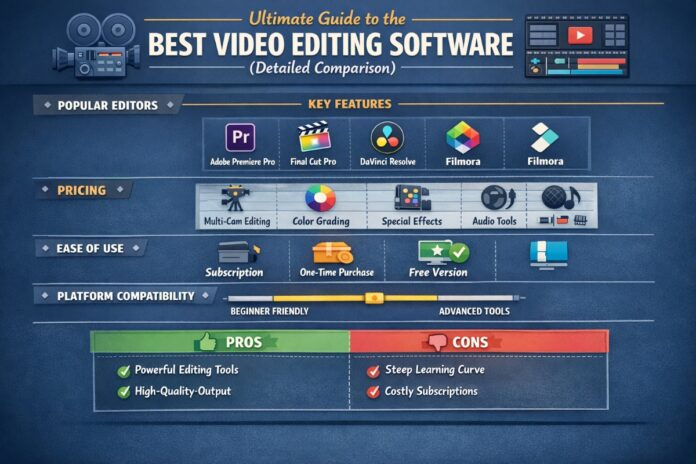
Best Video Editing Software 2026: Detailed Comparison & Reviews
Compare the Best Video Editing Software 2026 with detailed reviews, AI features, pricing, performance, and expert recommendations for YouTubers, filmmakers, and content creators.
Video content dominates digital communication in 2026. Whether you are a YouTuber, marketer, educator, or business owner, choosing the Best Video Editing Software 2026 directly impacts quality, efficiency, and audience engagement.
This comprehensive guide provides a detailed video editing software comparison covering features, AI capabilities, pricing, performance, and ideal use cases.
1. Introduction
Why Video Content Dominates in 2026
- 91% of businesses use video marketing.
- Video accounts for more than 82% of global internet traffic.
- Short-form video delivers the highest ROI on social platforms.
- 4K video adoption has increased significantly among creators.
Why Choosing the Right Software Matters
Your editing software determines workflow speed, rendering performance, creative flexibility, and scalability as your content grows.
2. What is Video Editing Software?
Definition
Video editing software is a digital tool that allows users to manipulate video clips, audio, images, and visual effects to produce a finished video.
Core Components
- Timeline: Where clips are arranged sequentially.
- Rendering Engine: Processes edits and exports final video.
- Codecs: Compression standards like H.264 and HEVC.
- Effects & Transitions: Visual enhancements and motion effects.
3. How Video Editing Software Works
Step 1: Import Media
Upload video clips, audio tracks, graphics, and other assets into the project library.
Step 2: Timeline Editing
Trim, split, arrange, and sequence clips using non-linear editing.
Step 3: Apply Effects and Transitions
Add motion effects, stabilization, transitions, and overlays.
Step 4: Color Grading
Adjust exposure, white balance, contrast, and apply LUTs.
Step 5: Audio Editing
Enhance voice clarity, reduce noise, and balance background music.
Step 6: Export and Render
Select resolution (1080p, 4K), codec, and platform preset for final output.
4. Key Features to Look for in 2026
- AI-powered editing tools
- Auto-captioning
- Motion tracking
- 4K / 8K support
- GPU acceleration
- Cloud collaboration
- Template libraries
- Plugin ecosystem
5. Detailed Reviews of Each Software
Cyberlink PowerDirector
Overview
PowerDirector offers strong performance, advanced AI tools, and fast rendering speeds.
Core Features
- Multi-track timeline
- Advanced color grading
- Motion tracking
- 8K support
Pros
- Fast rendering
- Strong AI tools
- Balanced usability
Cons
- Subscription cost
- Feature-heavy interface for beginners
Best For
YouTubers, marketers, intermediate creators.
Wondershare Filmora
Overview
Filmora is one of the best video editors for beginners with intuitive controls.
Core Features
- Drag-and-drop timeline
- Large effects library
- AI captioning
Pros
- Very beginner-friendly
- Affordable video editing software
- Template-rich
Cons
- Limited advanced grading
- Fewer pro-level controls
Best For
Beginners, social media creators.
Movavi Video Editor
Overview
Movavi provides clean interface editing with solid performance at a budget-friendly price.
Pros
- Easy learning curve
- One-time purchase option
Cons
- Limited plugin ecosystem
Best For
Freelancers, educators, small businesses.
Adobe Premiere Elements
Overview
Premiere Elements offers guided edits and Adobe-powered AI automation.
Pros
- One-time purchase
- Smart automation
Cons
- Less powerful than professional Premiere Pro
Best For
Hobbyists and Adobe ecosystem users.
Pinnacle Studio
Overview
Pinnacle Studio targets advanced hobbyists who need deeper editing control.
Pros
- Multi-camera editing
- Advanced keyframing
Cons
- Steeper learning curve
Best For
Advanced creators and semi-professionals.
6. Detailed Comparison Table
| Software | Pricing | AI Features | Ease of Use | 4K Support | Best For | Platform |
|---|---|---|---|---|---|---|
| PowerDirector | Mid-range | Advanced | Moderate | Yes | YouTubers | Windows/Mac |
| Filmora | Affordable | Strong | Very Easy | Yes | Beginners | Windows/Mac |
| Movavi | Budget | Moderate | Easy | Yes | Freelancers | Windows/Mac |
| Premiere Elements | One-time | Adobe AI | Moderate | Yes | Hobbyists | Windows/Mac |
| Pinnacle Studio | Tiered | Basic | Advanced | Yes | Advanced Users | Windows |
7. Benefits of Using Professional Video Editing Software
- Improved content quality
- Stronger branding consistency
- Higher engagement rates
- Better monetization potential
- Increased business growth
8. Pros and Cons of Video Editing Software
Pros
- Creative flexibility
- High-quality exports
- AI productivity tools
Cons
- Learning curve
- Hardware requirements
- Subscription costs
9. How to Choose the Right Video Editing Software
Based on Skill Level
- Beginners: Filmora
- Intermediate: PowerDirector
- Advanced: Pinnacle Studio
Based on Budget
- Budget option: Movavi
- One-time purchase: Premiere Elements
10. Best Software for Different Users
- Best for Beginners: Wondershare Filmora
- Best for YouTubers: Cyberlink PowerDirector
- Best Budget Option: Movavi Video Editor
- Best Overall in 2026: Cyberlink PowerDirector
11. Frequently Asked Questions
What is the best video editing software in 2026?
Cyberlink PowerDirector offers the best balance of performance, AI tools, and usability.
Is free software enough?
Free software works for basic projects, but professional needs require paid tools.
Which software is best for YouTube?
PowerDirector and Filmora offer optimized export presets for YouTube creators.
Is AI replacing video editors?
No. AI enhances workflow but does not replace creative decision-making.
12. Final Verdict
The Best Video Editing Software 2026 depends on your skill level, budget, and content goals.
For balance and AI capabilities, choose PowerDirector.
For beginners, choose Filmora.
For affordability, choose Movavi.
For one-time purchase with automation, choose Premiere Elements.
For advanced control, choose Pinnacle Studio.
Invest strategically and build a workflow that supports long-term content growth.
Frequently Asked Questions
What is the Best Video Editing Software 2026?
Cyberlink PowerDirector is the best overall video editing software in 2026 due to its strong AI tools, fast rendering performance, 4K/8K support, and balance between usability and advanced features.
Which is the best video editor for beginners?
Wondershare Filmora is the best video editor for beginners because of its intuitive interface, drag-and-drop timeline, built-in templates, and AI-powered automation tools.
What is the best video editing software for YouTube?
Cyberlink PowerDirector and Wondershare Filmora are excellent for YouTube creators thanks to optimized export presets, auto-captioning, and fast rendering performance.
Is free video editing software enough in 2026?
Free software is suitable for basic projects. However, professional content creators benefit from paid tools that offer advanced AI features, better rendering engines, and branding control.
What PC specs are required for 4K video editing?
For smooth 4K editing in 2026, you should have:
- Minimum 16GB RAM
- Dedicated GPU (NVIDIA/AMD)
- SSD storage
- Multi-core processor (Intel i7/Ryzen 7 or higher)
Are AI video editing tools replacing human editors?
No. AI video editing tools improve efficiency by automating repetitive tasks, but creative storytelling and decision-making remain human-driven.
Which is the most affordable video editing software?
Movavi Video Editor and Wondershare Filmora are among the most affordable video editing software options available in 2026.
Disclaimer:
This article may include content generated or assisted by artificial intelligence tools. All information has been carefully reviewed, edited, and verified to ensure accuracy, relevance, and quality. The purpose of using AI is to enhance research efficiency and improve clarity, while maintaining original insights and value for readers.