


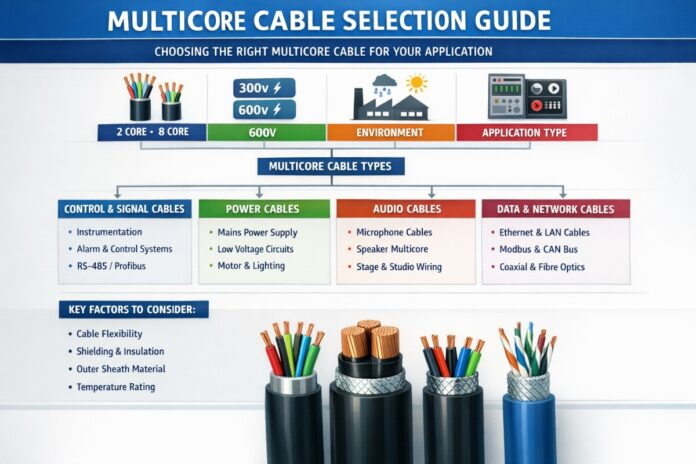
The article explains how to choose the right multicore cable for safe, efficient electrical use. It breaks down technical factors into practical guidance for selecting appropriate cables for power, control, and signal applications.
Multicore cables are widely used in electrical systems where multiple conductors are required in a single cable. They are commonly used in homes, industries, machinery, and control panels. Choosing the right multicore cable is important for safety, performance, and long service life.
This guide explains in simple terms how to select the right multicore cable.
What Is a Multicore Cable?
A multicore cable is an electrical cable that contains more than one conductor inside a single outer sheath. Each core carries electrical current and is insulated separately to prevent short circuits.
Examples include:
- 2 core cable
- 3 core cable
- 4 core cable
- 10 core cable or more
These cables are used for power supply, control systems, and signal transmission.
Why Selecting the Right Multicore Cable Is Important
Choosing the wrong cable can cause overheating, voltage drop, equipment failure, and fire hazards. The correct cable ensures safe operation, proper performance, and long lifespan.
Factors to Consider When Selecting Multicore Cable
1. Number of Cores
Select the number of cores based on your system requirement.
- 2 core – single phase power
- 3 core – phase, neutral, earth
- 4 core – three phase systems
- Multiple cores – control panels
2. Cable Size (Cross-Sectional Area)
Cable size is measured in square millimeters (mm²). Common sizes include 1.5 mm², 2.5 mm², 4 mm², and 6 mm².
Larger size cables carry more current and reduce overheating.
3. Current Carrying Capacity
Always select a cable that supports more current than your equipment requires. This improves safety and performance.
4. Voltage Rating
Common voltage ratings include:
- 300/500V
- 450/750V
- 0.6/1kV
Always use the correct voltage rating cable.
5. Type of Insulation
Common insulation types include:
- PVC – Affordable and widely used
- XLPE – Better heat resistance and longer life
- Rubber – Flexible and used in portable equipment
6. Armoured or Unarmoured Cable
Armoured cable is used in underground and industrial areas for protection.
Unarmoured cable is used indoors and in control panels.
7. Installation Environment
Consider where the cable will be installed:
- Indoor
- Outdoor
- Underground
- Wet areas
- High temperature areas
8. Flexibility Requirement
Flexible cables are used for moving equipment. Rigid cables are used for fixed installations.
9. Shielding Requirement
Shielded cables are used in signal and communication systems to prevent interference.
10. Quality and Brand
Always choose high quality cable for safety, reliability, and long life.
Common Applications of Multicore Cable
- Home wiring
- Industrial machines
- Control panels
- Motors
- Automation systems
- Power supply
Example of Cable Selection
If a motor requires 7 amps at 415V, you can select:
- 4 core cable
- 2.5 mm² size
- 1kV voltage rating
- Armoured cable
Mistakes to Avoid
- Choosing wrong cable size
- Buying cheap cable
- Ignoring environment
- Ignoring voltage rating
- Not using armoured cable when required
How to Identify Good Multicore Cable
- Check certification mark
- Check brand name
- Check insulation quality
- Ensure copper conductor
Copper vs Aluminium Cable
Copper cable: Better conductivity and longer life.
Aluminium cable: Lower cost but less efficient.
Safety Tips
- Do not overload cable
- Install properly
- Use correct size
- Use certified cable
- Hire qualified electrician
Conclusion
Selecting the right multicore cable ensures safety, efficiency, and long service life. Always consider cable size, voltage rating, insulation, protection, and installation environment before making a decision.
Never compromise on quality and safety.