

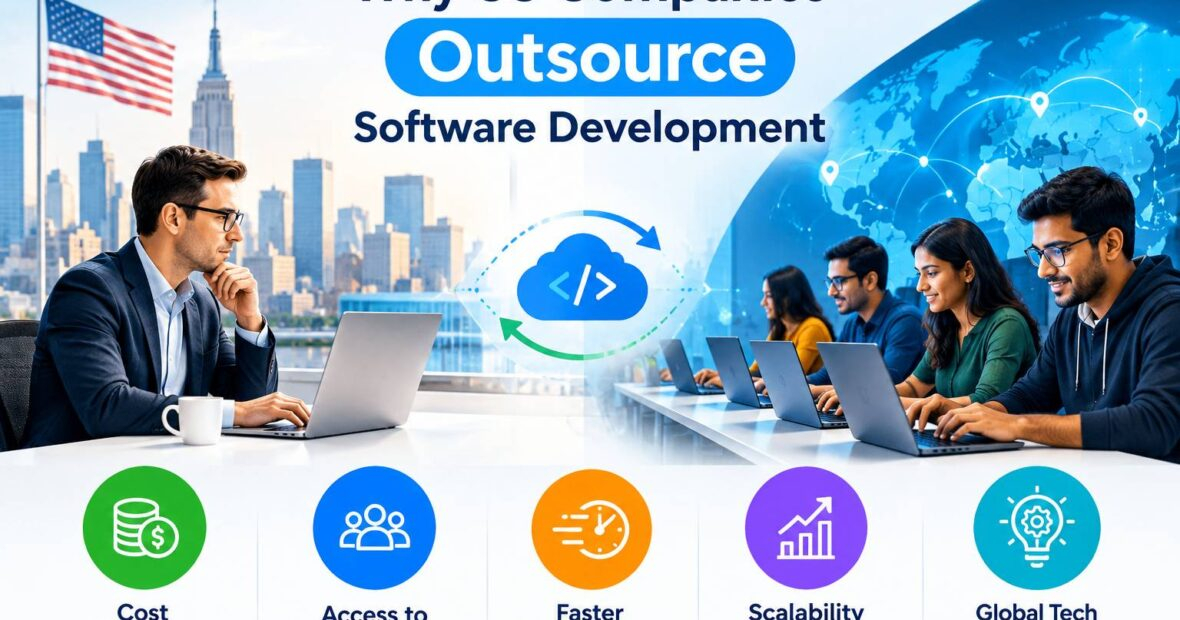
Ask a US operations leader why their last software project went to an outside team, and the answer is rarely about saving a few dollars. It usually sounds more like a scheduling problem. The roadmap was full, the open engineering roles were still unfilled after four months, and the launch date was not moving. Outsourcing became the practical way out.
This shift has become routine across industries, from regional insurers to hospital networks. Companies that work with partners like CRECSO tend to describe the decision as a response to specific constraints. This article looks at those constraints, where outsourcing helps most, and where it can go wrong.
The Hiring Gap Is Still the Biggest Driver
Software engineers are expensive to find, slow to hire, and hard to keep. A senior developer search can take three to six months once you count sourcing, interviews, offers, and notice periods. During that time the project either stalls or gets pushed onto a team that is already stretched.
An external partner changes that timeline. A established software development company already has engineers, designers, QA specialists, and project managers working together. A US business can start a project in weeks instead of waiting on a hiring pipeline. The team also arrives with experience from similar builds, which shortens the early guesswork around architecture and tooling.
Cost Is About Structure, Not Just Rates
Lower hourly rates get the headlines, but finance teams look at something else. A full-time engineer in the US carries salary, benefits, equipment, recruiting fees, training, and management overhead. Those costs continue whether the project is busy or quiet.
Outsourcing converts much of that fixed cost into a variable one. You pay for the capacity you need during the build, then scale down once the product is stable. For a large platform rebuild, an enterprise software development company can assemble a cross-functional team for the heavy phase without the company adding permanent headcount it may not need in year two.
There is a caveat. The cheapest quote is often the most expensive outcome if requirements are vague and rework piles up. Companies that save money through outsourcing usually spend more time up front defining scope.
Speed to Market Matters More Than Polish
For startups and for new product lines inside established companies, the first goal is learning whether anyone wants the product. Waiting a year to find out is a poor trade.
That is why many founders bring in an MVP software development company early. These teams have shipped first versions many times, so they know which features belong in the initial release and which can wait. A focused MVP built in a few months gives you real user feedback, something an internal team still learning the problem space may take much longer to produce.
Scaling a Subscription Product Without Overbuilding
Software-as-a-service products create a particular staffing problem. Early on you need a small, fast team. As customers arrive, you suddenly need multi-tenant architecture, billing logic, security reviews, and uptime monitoring, often all at once.
Working with a SaaS software development company lets a product team add that specialized capacity as the user base grows. A common pattern is for the founders to keep product strategy in-house while the partner handles platform engineering, integrations, and release management. The company keeps control of the roadmap and avoids hiring a dozen specialists before revenue justifies it.
Industry Pressures That Push Companies Outward
Some sectors outsource for reasons that go beyond general cost and speed. Their software has to meet regulations, connect to older systems, or work with physical equipment. Domain knowledge becomes the scarce resource, and it is hard to hire in bulk.
Healthcare and Compliance
Hospitals, clinics, and health startups work under HIPAA, strict audit expectations, and patient safety concerns. A mistake in a data flow is not just a bug. It can become a reportable incident. Many providers turn to a custom healthcare software development company because the team already understands consent handling, access controls, and the workflows clinicians follow in practice.
Virtual Care Platforms
The growth of remote visits after 2020 left many practices running on stitched-together video tools. Making virtual care reliable requires scheduling, secure messaging, e-prescribing, and billing to work as one flow. A telemedicine software development company can build that experience without pulling the practice’s own IT staff away from daily support.
Patient Records and Interoperability
Electronic records are where many health IT projects get difficult. Data has to move between labs, pharmacies, and billing systems, each with its own standards. An EHR software development company that has worked with HL7 and FHIR interfaces can save months of trial and error that an internal team would otherwise absorb.
Logistics and Supply Chains
Carriers and freight brokers run on thin margins and live data. Route planning, tracking, warehouse coordination, and carrier integrations all need to work reliably during peak season. A logistics software development company brings experience with telematics feeds and dispatch logic, which lets operators improve visibility without building a research team of their own.
Customer Relationship Systems
Off-the-shelf CRM platforms handle common sales workflows well, but companies with unusual pipelines or complex account structures often outgrow them. A CRM software development company can tailor the system to the way the business actually sells, or connect an existing platform to billing and support tools so teams stop re-entering data.
Real Estate Operations
Brokerages, property managers, and developers juggle listings, tenant requests, leases, and payments, often across several disconnected tools. A real estate software development company can unify those pieces into a single portal. For a mid-sized property manager, that can mean tenants pay rent, submit maintenance tickets, and sign renewals in one place.
Manufacturing Floors
Plants run on equipment that may be decades old, and software has to coexist with it. Production tracking, quality checks, and maintenance scheduling all depend on reliable data from the floor. A manufacturing software development company understands that downtime is costly, so it plans rollouts around production schedules rather than around a developer’s convenience.
Connected Devices
Firmware is a specialty of its own. Memory limits, power consumption, real-time behavior, and hardware testing all shape the code. Few US companies keep a large embedded team on staff unless hardware is their core business. Most hire an embedded software development company for the product cycle and keep a small internal group for maintenance.
Retail and Commerce
Retailers deal with seasonal spikes, inventory across channels, and customers who expect checkout to work on the first try. A retail software development company can build point-of-sale integrations, loyalty tools, and inventory sync that hold up during a holiday rush, which is difficult to test properly with a small internal team.
Insurance and Claims
Insurers carry legacy policy systems alongside new pressure to offer digital quotes and faster claims. Replacing everything at once is risky, so many carriers modernize in stages. An insurance software development company can build new customer-facing layers on top of existing cores, then move functions over as confidence grows.
The Risks Worth Taking Seriously
Outsourcing is not automatically the right call. Communication gaps are the most common failure, especially when time zones differ and nobody sets a regular rhythm for check-ins. Intellectual property terms need to be clear in the contract. Security practices should be reviewed before any code or customer data changes hands.
Another quiet risk is knowledge loss. If the partner holds all the context and the internal team never learns the system, switching vendors later becomes painful. Strong engagements include documentation, code reviews that the client can read, and a plan for handover.
Choosing a Partner Without Regret
A few habits separate good outsourcing experiences from bad ones. Ask for examples from your industry and talk to previous clients rather than relying on a case study page. Start with a small paid pilot before committing to a large contract. Expect the partner to challenge your requirements, because a team that agrees with everything is often not looking closely enough.
Keep a product owner on your side with real decision-making authority. Outsourced teams move fast, but they cannot guess your priorities.
The Bottom Line
US companies outsource software development because it solves problems they face right now: scarce talent, uneven workloads, tight launch windows, and industries that demand specialized knowledge. The model works best when the company stays clear about what it owns, which is the vision, the priorities, and the customer relationship, and treats the partner as an extension of the team rather than a black box. Done carefully, it gives smaller teams a way to build things that once required a much larger payroll.