
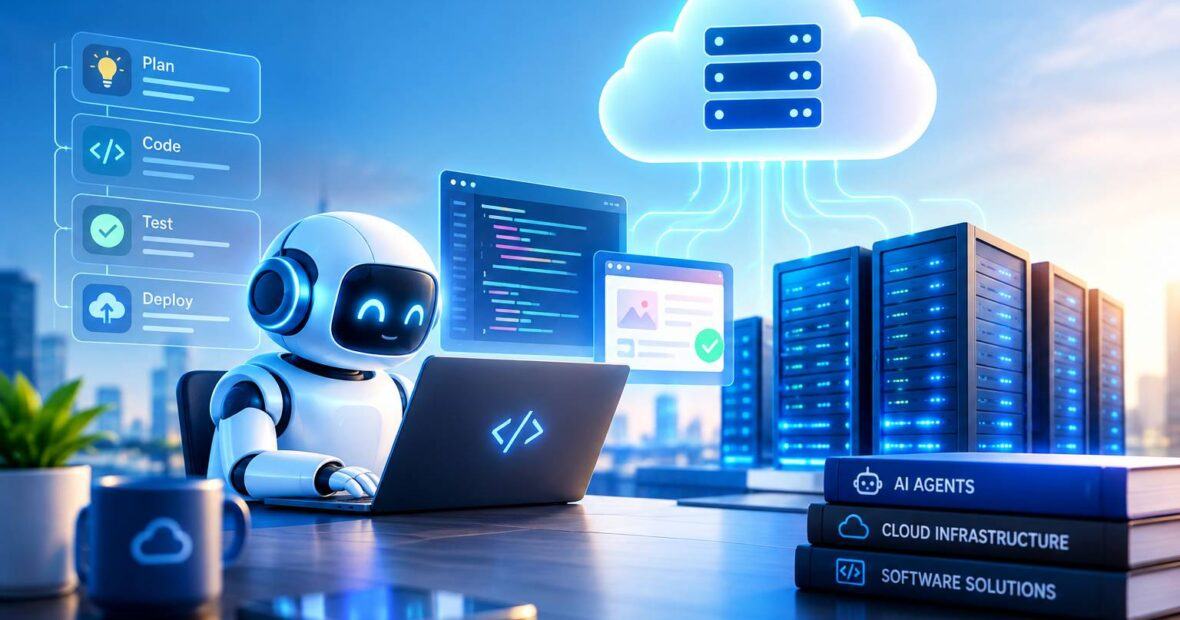
It has never been easier to build software. A founder can describe an app to tools like Lovable, Replit or Bolt and have a working product by the afternoon. AI coding agents handle the front end, the database and even the first deployment. The harder question comes later. Where should that software actually live once real customers, real data and real money are involved?
Choosing cloud servers for software built by AI agents is not the same as hosting a hand-coded app. Agent-generated code often works well on the surface but carries hidden gaps in security rules, database design and scaling. The default hosting that comes with a builder tool is fine for a demo. It is rarely the right long-term home. At CRECSO, a growing share of our projects start with a business owner who built a promising app with AI and now needs it to run safely at scale.
This guide explains what makes AI-built software different, the hosting options available, a real lesson from Lovable, the common mistakes and a step-by-step plan for moving to production-grade cloud servers for software your customers rely on.
Why AI-Built Software Needs a Different Hosting Plan
AI coding agents optimize for “it works.” They are less reliable at “it works safely for 10,000 users.” That gap shows up in a few predictable places:
- Security rules: Database access policies and API permissions are often missing or too open.
- Performance: Queries that run fine with 50 records can stall with 50,000.
- Secrets: API keys sometimes end up in front-end code.
- Observability: Logging and alerts are rarely set up by default.
None of this means AI-built software is bad. It means your cloud servers for software need to catch what the agent missed.
Choosing Cloud Servers for Software Built by AI Agents
Most AI-built apps follow a similar stack: a React or Next.js front end, a Postgres database often through Supabase, and a few serverless functions. That gives you several realistic hosting paths.
| Option | Best For | Main Limitation |
|---|---|---|
| Builder’s built-in hosting | Prototypes and demos | Limited control, security and compliance |
| Managed platforms (Vercel, Netlify plus Supabase) | Early-stage startups | Costs rise with traffic, less network control |
| Public cloud (AWS, Azure, Google Cloud) | Growing products and SMEs | Needs DevOps skills to set up well |
| Private or hybrid cloud | Regulated industries | Higher setup cost |
What Production-Ready Cloud Servers for Software Should Include
- Separate development, staging and production environments.
- Managed databases with backups, point-in-time recovery and row-level security.
- Secrets stored in a vault, never in code.
- A web application firewall and rate limiting.
- Logging, uptime checks and error tracking.
- Automated deployments with rollback.
The AWS Well-Architected Framework is a useful reference here. Its pillars on security, reliability and cost apply whether a human or an agent wrote the code.
Real Business Example: Lovable and the Database Security Lesson
- Business challenge: Lovable, an AI app builder, grew extremely fast and reportedly reached $100 million in annual recurring revenue within about eight months of launch in 2025. Thousands of users shipped apps backed by Supabase databases.
- Solution: The platform made building and deploying effortless, which was the point. But database access rules depended on correct configuration.
- Implementation: In 2025, a security researcher scanned around 1,600 Lovable-built apps and reported that more than 170 exposed user data because row-level security rules were missing or weak. The issue was published as a CVE, and Lovable added a security scan that checks for these gaps before publishing.
- Outcome: The fix was a configuration control on the cloud servers for software users had shipped, not a rewrite of every app.
- Business impact: If you built your product with an AI tool, assume its security settings need a human review before customer data goes in.
Security teams reviewing AI-built apps may find helpful context on AI for security.
Pros and Cons of Building With AI Coding Agents
| Pros | Cons |
|---|---|
| Very fast path from idea to working product | Hidden security and performance gaps |
| Lower early development cost | Code can be hard to maintain without cleanup |
| Easy to test ideas with real users | Default hosting rarely fits compliance needs |
Best Practices
- Run a code and security review before going live.
- Load test with realistic data volumes.
- Keep the code in your own Git repository so you are not locked to one builder.
- Use infrastructure as code so environments can be rebuilt.
- Set up cost alerts on all cloud servers for software in production.
Common Mistakes to Avoid
- Launching on the builder’s demo hosting with real customer data.
- Exposing database keys in browser code.
- No backups until something breaks.
- Letting the AI agent push directly to production.
How to Get Started
- Export the code to a private repository.
- Audit authentication, database rules and secrets.
- Choose cloud servers for software based on traffic, compliance and budget.
- Set up staging and production with automated deployments.
- Add monitoring, then migrate users in stages.
If the jump from prototype to production feels big, our MVP development services help harden AI-built products for real users.
Go-live checklist:
- Row-level security enabled and tested
- No secrets in client code
- Backups verified with a restore test
- Error tracking and uptime alerts live
- Rollback plan documented
Teams that need to move from a builder platform to AWS or Azure can use our cloud migration services.
Future Trends
AI builders will add stronger default security, one-click export to major clouds and built-in compliance checks. At the same time, more companies will adopt a two-stage model: build fast with agents, then move to managed cloud servers for software that needs to scale.
Key Takeaways
- AI-built apps work quickly but often miss security and scaling details.
- Builder hosting suits demos, not most production workloads.
- Separate environments, backups and access rules are non-negotiable.
Conclusion
AI coding agents have made building software faster than ever, but hosting still decides whether that software is safe and reliable. The right cloud servers for software built by agents add the guardrails the code may lack. CRECSO helps US founders and SMEs review, secure and host AI-built products on cloud platforms that fit their growth plans. Ready to move past the prototype? Talk to our application team today.