


One of the main conveyors at my friend’s plant had stopped suddenly. The reason was bearing failure. However, it wasn’t just any failure; a “reliable” part they had obtained from a vendor who had promised “OEM-equivalent” specs at a 30% discounted price, had literally come apart under the radial and axial load.
The time they were not in production due to this resulted in a loss of nearly ₹50 Lakhs in production.
We all have experienced a situation where we are under pressure to reduce the capital expenditure, the procurement KPIs are staring at us, and the local Tapered Roller Bearing Manufacturer sends over a catalog that looks, well, professional enough. But in the industrial world, especially in the high-stakes Indian manufacturing landscape, “good enough” is often the most expensive mistake one will ever make.
In fact, today I will take you behind the scenes. We are going to discuss the inside story of a tapered roller bearing manufacturer factory and the engineering department by which a “part” is differentiated from a “solution”. This is not merely about steel and grease; it is about the physics of reliability.
Why Tapered Bearings are the “Workhorses” of Industry
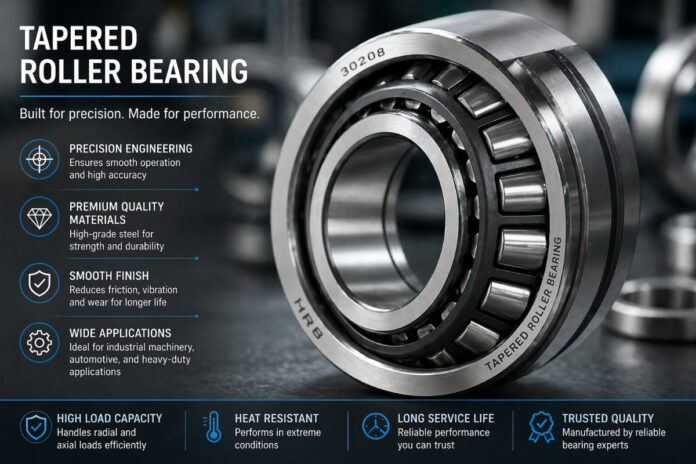
First, we need to discuss the “what” before the “who”. Tapered roller bearings are quite different from others. While ball bearings excel in high speeds, they are weak under heavy loads; cylindrical rollers are perfect for handling radial loads but cannot withstand thrust loads; however, the tapered design can handle various demands simultaneously.
Picture a heavy truck turning hard. Its weight pushes down, while force pulls sideways too. Tapered rollers handle both. These parts sit at an angle inside the bearing. They manage intense pressure from above plus stress from the side. Think of giant wind blades spinning fast. Wind tugs them one way, gravity pulls another. The shape makes it possible. Cones meet forces together. Without that tilt, things might fail under strain.
The “India Factor” in Sourcing
In India, “extreme” becomes the norm, so to speak. Besides the scorching temperatures, we have dusty environments in the mining and construction industries; and to be honest, sometimes machines are idle only a few few hours a week yet they undergo stress several times their rated capacity. A Tapered Roller Bearing Manufacturer selling to the Indian market needs to remember that their product will not be placed in a pristine, climate-controlled lab. More likely it will find use in a sugar mill in UP or a textile unit in Coimbatore.
1. Steel Quality: It’s Not Just “Iron”
In fact, you should seriously consider walking away if a manufacturer tries to talk about pricing before explaining “Steel Cleanliness” to you.
Simply put, a bearing’s core is its metallurgy. Most top-tier bearings utilize a “Case-Hardened” or “Through-Hardened” high-carbon chrome steel. But the catch is: it’s the impurities that cause the failure. We are talking about “macro-inclusions”, very fine particles of non-metallic substances trapped in the steel. When subjected to the repeated stress of millions of rotations, these inclusions are like small grenades hidden inside. They generate stress risers. Steel eventually “spalls” or flakes off.
Questions for Your Manufacturer
- Ever worked with vacuum-degassed steel? Pulling gases out of liquid steel is what this process does.
- Start by asking – what score would you give on inclusion? Without a clue here, clearly they aren’t leading the pack among Tapered Roller Bearing Makers. Finish knowing that gap matters.
- Starts with knowing where each bearing began. Can they follow one piece straight to its original metal lot? This detail matters more than most realize. Believe that.
- The Shape of the Logarithmic Pattern
Hold on tight – this might get a bit geeky. But stick around.
Heavy loads make roller edges dig into the raceway inside basic bearings. These rollers resemble simple cylinders, sometimes cone shaped. That digging effect goes by the name edge loading. Think of high heels on wood floors. One small area takes all the pressure.
The best Tapered Roller Bearing Manufacturer adopts Logarithmic Profile contouring.
Just a tiny shift in the roller’s form – mere microns – adjusts how force spreads from end to end. Because of that, stress spikes fade out, leaving behind smoother load distribution. These shifts go unseen up close, yet their effect shows clearly after years of running, deep into the tenth thousand hour mark.
3. Heat Treatment: The Dark Art of Durability
You may have the best steel around, but if the heat treatment is off, then that steel is waste. Heat treatment is responsible for a bearing’s hardness (and therefore, resistance to wear) as well as its toughness (i.e. the ability to withstand cracking).
In India, there are some “fly-by-night” workshops that basically treatment metals as a blacksmith would. They heat the metals, dunk them in oil, and cross their fingers.
A dependable manufacturer will use controlled atmosphere furnaces. They will “Retained Austenite” levels a state within the steel’s microstructure. An excess of it leads to an unstable bearing that changes in size over time. A deficiency will make the bearing brittle. This is a balancing act. In a way, it’s baking sourdough bread where the temperature and time have to be spot on or else the whole thing fails.
4. Understanding Surface Finish (Ra Values)
Look, we all know if you run your fingers over a bearing, it feels smooth, right? Very wrong. Under the microscope, a cheap bearing looks like the surface of the moon.
During spinning of a bearer, those peaks “plow” into each other. This causes friction. Friction generates heat. Heat destroys lubricant. When there is no lubricant left, the bearing is finished.
Top level manufacturers of Tapered Roller Bearings reckon “Super-finishing” as a necessary heavy investment. They employ abrasive stones to polish raceways right up to mirror-like finish (such low Ra value = mirror surface).
- Less Friction: This means faster running of the machine.
- Less Heat: Your grease gets to last twice as long.
- Quiet Operation: If your shop is as noisy as an airport terminal, you have surface finish problems.
5. The “System” Approach: Don’t Just Buy a Part
One mistake I often see, and honestly call it the most common one, is treating a bearing like a commodity, as if you are buying a box of nails.
A bearing belongs to a system comprising shaft, housing, seals, and lubrication. Reliable Tapered Roller Bearing Manufacturer not only deliver a box but also question your “Application.”
TIP: When sourcing for high contamination environment (like a coal washery), request “Specialized Sealing.” A bearing is only as good as its seal that keeps dirt out.
The Role of Lubrication
I have witnessed a brand-new set of tapered rollers failing within three days only. Why? The customer used a high-pressure grease whereas the manufacturer had recommended a light oil mist. Here, the “Manufacturer” was just a vendor who didn’t bother to inquire about the lubrication method. A reliable partner would have spotted that during the technical review.
6. Verifying
How then, can you tell if the bearing will survive 50, 000 hours? The manufacturer must have already “killed” a thousand in their lab.
It is desirable to seek out a manufacturer who has:
- Life Testing Rigs: They literally run bearings to death under extreme loads to verify their L10 life calculations.
- Check each bearing for noise one at a time. When vibration shows up, the part fails – no exceptions. A machine hums too loud? That unit won’t pass inspection. Quiet operation isn’t optional. Each test ends only when stillness is confirmed.
- Bent over calipers, they track sizes down to a micron – tiny thing, one thousandth of a millimeter. Precision lives there, hidden in decimal shadows.
7. Auditing
When you go for a factory visit (which is a must for a big contract), do not only admire the shiny machines. Also, give your attention to the “boring” stuff.
- Dust Control: Is the assembly area neat? If the air is full of grinding dust around the packing of bearings, then you are doomed.
- Calibration Stickers: Look at the measuring instruments. Are the stickers of calibration up to date?
- The Rejects Bin: Even though it might feel weird, I always have a peek at the bin of scrap. If a manufacturer says they have “Zero Rejects” you can be sure that they are lying. A manufacturer with a properly arranged scrap bin is a one who has a strict QC process. They are the ones that catch all the errors so that you do not have to.
8. Sustainability Shapes Tomorrow’s Manufacturing
One thing stands clear by 2026 – what we do to nature hits back hard. A trusted maker of Tapered Roller Bearings has turned toward remaking old parts instead of always building new ones.
Instead of disposing of a huge 500mm steel mill bearing, can it be re-ground? Can the rollers be changed? This can substantially save 50-60% of the cost and at the same time, importantly, lower the carbon footprint. If your manufacturer does not talk about “Circular Economy” or “Reman, ” then they are living in the 1990s.
Conclusion:
Sourcing is not easy. It is a balancing act between the Finance department and Engineering department. But ultimately, a bearing is the very pivot point of your entire operation.
When you are identifying a Tapered Roller Bearing Manufacturer, do not be looking only for a vendor. Search for an engineering partner who shares the same level of concern for your “MTBF” (Mean Time Between Failures) as you do.
You need to look for steel quality, logarithmic profiles, heat treatment precision, and also the honesty to tell you when a particular bearing is not suitable for your application.
It is better to spend some additional time and maybe a bit extra money in the initial stages, than to be like my friend in Rajasthan who was staring at a red alarm clock at 2 AM and wishing he had asked just a few more questions.
What you should do next? Go to your stores randomly. Pick a bearing box. Look at the manufacturer. Do they meet these criteria? If no, then it may be time for a very important discussion.