

TL;DR — Quick Summary
- Guest posting earns editorial backlinks that improve domain authority and keyword rankings.
- Target topically relevant sites with real organic traffic — not just high DA numbers.
- Diversify anchor text: 40–50% branded, 5–10% exact match maximum.
- Use Google operators, competitor backlink analysis, and Content Explorer to find opportunities.
- Pitches should be short, personal, and reference specific content on the target site.
- TAT (turnaround time) typically ranges from 2–6 weeks — communicate this clearly to clients.
- Paid placements are effective but should constitute a minority of your link profile.
- Start guest posting once you have 5–10 quality pages on your site.
- Track results monthly and monitor that links remain live.
- Consistent execution over 6–12 months produces compounding results.
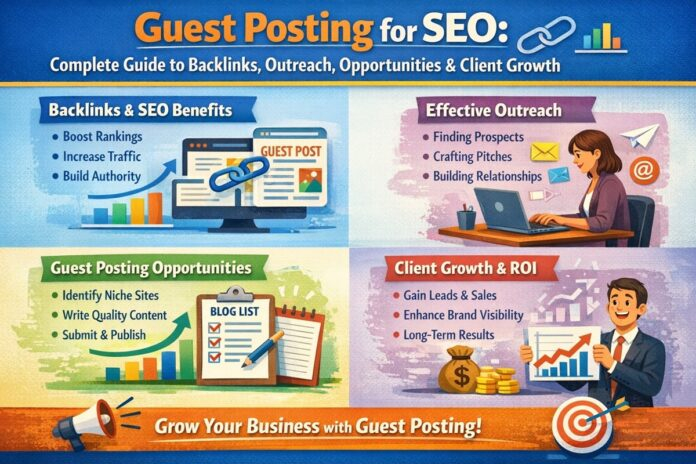
Guest posting for SEO has become one of the most powerful ways to build authority, earn high-quality backlinks, and reach new audiences, but the rules have changed. It is no longer about publishing on as many sites as possible.
Today, a single guest post on the right website can boost your credibility, improve your Google rankings, and bring consistent traffic for months or even years. Businesses, bloggers, and SEO professionals are using strategic guest posting to grow faster, strengthen their online presence, and stay ahead of competitors.
Understanding how guest posting really works can open the door to better visibility, stronger authority, and long-term SEO success.
Every major brand you admire built its authority partly through guest posting. Here’s exactly how to do it — from finding your first opportunity to running a full-scale operation for clients.
Table of Contents
- What Is Guest Posting
- What Keywords Should You Use in Guest Posting
- What Is Guest Posting in SEO
- How to Find Guest Posting Opportunities
- How to Do Guest Posting
- What Is Guest Posting Service
- How to Research Sites for Guest Posting
- What Is Paid Guest Posting
- What Is TAT in Guest Posting
- When Can You Start Guest Posting
- How to Find Clients for Guest Posting
- How to Use Guest Posting for Content Marketing
- How Guest Posting Improves Domain Authority
- How to Improve Website SEO Through Guest Posting
- Expert Tips
- Common Mistakes to Avoid
- Conclusion
- FAQ
In 2012, a single guest post on a major marketing blog helped an unknown startup get 100,000 new users in 24 hours. The company was Buffer. The tactic was guest posting. The results changed how the digital marketing world thinks about content as a distribution channel.
Fast-forward to today, and guest posting for SEO has become one of the most contested — and most misunderstood — strategies in the industry. Done right, it builds genuine domain authority, earns powerful editorial backlinks, and opens doors to audiences you’d never otherwise reach. Done wrong, it gets your site penalized.
This guide cuts through the noise. Whether you’re a freelancer landing your first placement, an in-house SEO building a link-building program, or an agency scaling guest post services for clients — you’ll find a clear, actionable framework here.
What Is Guest Posting?
The relationship is mutually beneficial by design. The host site gets free, high-quality content from an outside expert. The guest author gets exposure to a new audience and, crucially for SEO, an editorial backlink from an established domain.
Guest posting is not the same as link buying, private blog networks (PBNs), or content syndication. It’s an editorial arrangement — your content must genuinely serve the host’s readers, or the arrangement loses value for everyone involved.
The Three Pillars of Effective Guest Posting
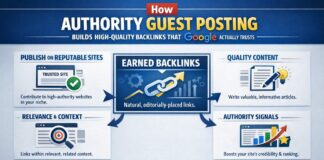
- Relevance: The host site must be topically aligned with your niche. A backlink from an unrelated site carries far less SEO weight and signals spam to Google.
- Authority: The host domain should have genuine organic traffic and domain authority — not just a number on a metric tool, but real editorial credibility.
- Quality: The content must be genuinely useful. Google’s quality raters evaluate guest content the same way they evaluate any other content. Thin, keyword-stuffed articles will hurt both parties.
What Keywords Should You Use in Guest Posting?
Keyword strategy in guest posting operates on two levels: the keywords you target within the article itself, and the anchor text you use for your backlinks. Both matter enormously.
Keywords Within the Article
The host site benefits when your article ranks. If your content helps their domain capture search traffic, they’re far more likely to accept future contributions and give your piece prominent placement. Research what keywords the host site currently ranks for, identify gaps, and pitch topics that fill those gaps.
Use tools like Ahrefs, Semrush, or Google Search Console to identify low-competition, mid-volume keywords relevant to the host’s audience. Target informational or comparative intent keywords — “how to,” “what is,” “best practices for” — as these are easiest to pitch and publish.
Anchor Text Strategy for Your Backlinks
This is where most SEOs either win or lose with guest posting. Google analyzes anchor text distribution across your entire backlink profile. An unnatural concentration of exact-match anchors is a clear penalty signal.
Recommended anchor text distribution for guest post backlinks:
| Anchor Type | Example | Recommended % | Use Case |
|---|---|---|---|
| Branded | “Acme Marketing” | 40–50% | Brand recognition, low risk |
| Naked URL | “acme.com” | 15–20% | Natural-looking profile |
| Generic | “learn more,” “this guide” | 10–15% | Diversification |
| Partial Match | “marketing strategies guide” | 15–20% | Topic relevance signals |
| Exact Match | “guest posting for SEO” | 5–10% | High-authority placements only |
Pro Tip: Guard your exact-match anchors carefully — use them sparingly and only on your highest-authority placements.
What Is Guest Posting in SEO?
In the context of SEO, guest posting is primarily a link-building strategy. Backlinks remain one of Google’s top three ranking factors. But not all backlinks are equal — editorial links earned through original content on legitimate websites carry far more weight than links acquired through directories, comments, or link exchanges.
A well-executed guest posting program does multiple things simultaneously for SEO:
- Builds domain authority: Links from high-DA sites transfer significant PageRank to your domain, improving your overall ranking capacity across all pages.
- Builds topical authority: When your byline appears consistently on respected sites in your niche, Google’s entity recognition systems associate your brand with that topic area.
- Drives referral traffic: Beyond SEO, a well-placed article on a site with genuine readership sends real visitors who convert.
- Improves brand trust signals: Being featured on established publications creates E-E-A-T signals (Experience, Expertise, Authoritativeness, Trustworthiness) that Google increasingly values.
- Accelerates indexing: New pages on your site get indexed faster when established sites are linking to them, because Googlebot follows those links.
It’s worth stating clearly: Google’s guidelines prohibit “large-scale article marketing or guest posting campaigns with keyword-rich anchor text links.” The key phrase is large-scale and keyword-rich. Quality-focused guest posting that produces genuine editorial value is explicitly distinguished from spammy link schemes.
How to Find Guest Posting Opportunities
The best guest posting opportunities are rarely advertised. You find them through research, competitive intelligence, and direct outreach.
Google Search Operators
Search operators let you surface sites actively accepting guest contributions. Use these queries, substituting your niche keyword:
[niche] "write for us"[niche] "submit a guest post"[niche] "become a contributor"[niche] "guest post guidelines"[niche] inurl:guest-post[niche] "this is a guest post by"
Competitor Backlink Analysis
This is the highest-yield method. Plug your top 3–5 competitors into Ahrefs or Semrush, go to their backlink profiles, and filter for dofollow links from referring domains. Sort by domain rating. Any site that has published a guest post for your competitor is a warm prospect for your outreach — you already know they accept guest content in your niche.
Author Bio Tracking
Find well-known contributors in your niche. Search their name in Google along with “guest post” or “contributor.” This surfaces the sites they write for. If those sites are a fit, you have a proven guest-posting outlet and a benchmark for content quality.
Content Explorer Tools
Ahrefs’ Content Explorer lets you search any topic and filter results by domain rating, organic traffic, and publishing date. Look for articles that include “by [author name]” patterns, which often indicate guest contributors.
Niche Communities and LinkedIn
Many editors announce open contributor slots in niche Facebook groups, Slack communities, and LinkedIn posts. Follow editors and content managers at publications in your space. Being first to respond to a call for contributors often gets you in the door without a formal pitch process.
How to Do Guest Posting: A Step-by-Step Process
- Build a prospect list. Use the research methods above to compile 30–50 target sites. Include their URL, DA/DR score, estimated traffic, contact email, and notes on their content focus. Quality matters more than quantity — 10 great placements beat 50 mediocre ones.
- Qualify each site rigorously. Verify: Does the site have real organic traffic? Is it indexed in Google? Does it have a genuine engaged audience? Avoid sites with inflated DA scores but zero organic traffic — these are often part of private blog networks.
- Study the publication deeply. Read their top 10 most-shared articles. Understand their tone, depth, format, and audience level. Your pitch must demonstrate that you’ve done this. Generic pitches are deleted in seconds.
- Craft a targeted pitch email. Your outreach email should be short (under 200 words), personal, and immediately valuable. Reference a specific article they published. Propose 2–3 concrete topic ideas. Include one sentence on why you’re qualified to write on this topic.
- Write exceptional content. Once approved, write a piece that’s better than anything already on their site covering that topic. Use original research, data, examples, and insight. Aim for at least 1,500–2,500 words. Include your contextual backlink naturally within the body — not crammed into the author bio.
- Follow up once. If you don’t hear back within 7 days, send one brief follow-up. If still no response, move on. Never follow up more than twice — it damages your reputation.
- Promote the published article. Share it on your social channels, link to it from your own site where relevant, and notify anyone mentioned in the piece. This drives traffic to the host site and builds goodwill for future contributions.
- Track and report results. Monitor referral traffic, anchor text of your backlink, DA of the placement, and keyword ranking improvements.
Subject: Article idea for [Site Name]: [Specific Proposed Title]Hi [Editor’s name], I read your piece on [specific article] — particularly your point about [specific insight]. I think your audience would benefit from a follow-up covering [topic gap]. I’m a [brief credential] who has [relevant experience]. Here are three specific angles: [1], [2], [3]. Happy to share writing samples. Is this a fit?
What Is a Guest Posting Service?
A guest posting service is a company or freelancer that manages the entire guest posting process on behalf of a client — from prospecting and outreach to content creation and placement reporting.
Services typically offer tiered packages based on the domain authority or traffic of the placements they can secure. A basic tier might offer placements on sites with DR 20–40, while premium tiers include placements on DR 60+ or niche-specific industry publications.
What a Legitimate Guest Posting Service Delivers
- A vetted list of real, traffic-generating publications (not PBNs)
- Custom-written, original content — not spun or recycled articles
- Dofollow backlinks with natural anchor text
- Transparent reporting with live URLs, DA/DR, and traffic estimates
- Topic approval before writing begins
- Content that remains published (a reputable service offers at least 12-month guarantees)
Red Flags in Guest Posting Services
- Very low prices (under $50 per placement) almost always mean PBN or low-quality sites
- Inability to show you the sites before you pay
- No content samples or named writers
- Anchor text that’s all exact-match keywords
- Promises like “1,000 backlinks in 30 days”
How to Research Sites for Guest Posting
Site qualification is where experienced link builders separate genuine opportunities from traps. Here’s a systematic checklist.
Technical Checks
- Organic traffic: Use Semrush or Ahrefs traffic estimate. Legitimate sites should show consistent organic traffic. Flat or zero traffic is a warning sign.
- Indexed pages: Search
site:domain.comin Google. Tens of thousands of indexed pages with no recognizable content indicates a content farm. - Spam score: Moz’s spam score should ideally be under 5%. Scores above 30% indicate serious problems.
- Link velocity: In Ahrefs, check the referring domains graph. Sudden spikes in link acquisition are a red flag for manipulated authority.
Editorial Quality Checks
- Do real authors write for this site? Can you find their LinkedIn profiles or other published work?
- Is the content editorial and original, or does it read like mass-produced filler?
- Does the site have a genuine social media presence and engagement?
- Are there identifiable editors or editorial staff?
- Does the site have a clear niche, or does it cover every topic under the sun?
Link Profile Checks
- What kinds of sites are linking to this domain? If most backlinks come from other content farms, the authority is manufactured.
- What is the ratio of dofollow to nofollow links in the site’s outbound link profile? Sites that sell links often show unusual patterns.
What Is Paid Guest Posting?
Paid guest posting refers to arrangements where a site charges a fee in exchange for publishing your article and including your backlink. This practice sits in a gray area — technically, Google’s guidelines require that paid links carry a rel="sponsored" or rel="nofollow" attribute, which eliminates their SEO value.
In practice, many publishers charge “editorial fees” while still passing link equity. This is common on mid-tier industry publications and news sites.
Navigating Paid Placements Safely
- Never accept a placement where the site makes it obvious they’ll publish anything for a fee — these sites become targets for Google manual actions.
- Prioritize placements where the fee covers editorial review and the publication genuinely curates contributors.
- Ensure the site has real organic traffic — a site with no traffic delivering a paid dofollow link offers almost zero value.
- Keep paid placements as a minority of your overall link-building strategy. Over-reliance on paid placements creates an unnatural, detectable profile.
What Is TAT in Guest Posting?
TAT stands for Turnaround Time — the total duration from initial order or agreement to the live publication of the guest post. Understanding TAT is essential for project management and client expectation setting.
| Stage | Typical Duration | Notes |
|---|---|---|
| Outreach & acceptance | 3–14 days | Longer for premium publications |
| Content writing | 2–5 days | Depends on word count & complexity |
| Client review (if applicable) | 1–3 days | Build this into the timeline |
| Editorial review by host | 3–14 days | Highly variable |
| Revisions | 1–5 days | Common on strict publications |
| Publishing & live URL | 1–3 days after approval | Some sites batch-schedule |
| Total typical TAT | 2–6 weeks | High-authority sites: up to 12 weeks |
When quoting TAT to clients, always add buffer time. Client-facing deadlines should assume the longer end of each stage.
When Can You Start Guest Posting?
You can start guest posting as soon as your website has a solid foundation. That means:
- At least 5–10 published pages of original, quality content. Editors will check your site before accepting your pitch. A thin or half-finished site signals amateur hour.
- A clear niche or topical focus. Your site should be unambiguous about what it’s about.
- A functional, professional design. It should load fast, be mobile-friendly, and look credible.
- Clear contact information and an author bio page. Editors will look for evidence that you’re a real person with a real perspective.
You do not need to wait until your site reaches a certain DA threshold. Many new sites have successfully earned links from DR 60+ publications within their first six months by focusing on original insight and excellent pitching.
How to Find Clients for Guest Posting
If you’re an SEO agency or freelancer looking to offer guest posting as a service, client acquisition follows several proven channels.
Inbound Through Your Own Guest Posts
Publish your own guest posts about guest posting strategy, link building, or SEO on marketing publications. Your author bio becomes a lead generation asset. When your target clients read about a topic and see your name attached to expert content, inbound inquiries follow naturally.
LinkedIn Outreach
Filter LinkedIn for SEO managers, content directors, and marketing managers at companies with 10–200 employees. Lead with a specific observation about their backlink profile, not a generic service pitch. “I noticed your site ranks on page 2 for [keyword] — your DR is strong but the link profile shows gaps in [topic cluster]” outperforms “Hi, I offer guest posting services.”
Cold Email Campaigns
Use tools like Hunter.io or Apollo to find marketing contact emails. Build personalized sequences of 3–4 emails with value at each touch. The first email offers a free backlink profile analysis. The second follows up with a specific insight. The third makes an offer. The fourth is a breakup email — which often converts the highest.
SEO Communities
Groups like “SEO Signals Lab” and niche-specific Facebook and Slack communities are active marketplaces where clients post guest posting needs regularly. Being genuinely helpful and visible — not just advertising — builds the reputation that attracts inbound requests.
Referral Partnerships
Build relationships with web designers, developers, and content agencies that don’t offer link building. A mutual referral arrangement creates a steady pipeline of clients without any advertising spend.
How to Use Guest Posting for Content Marketing
Guest posting is not just a link-building tactic — it’s a content distribution and brand-building channel. The smartest content marketers use guest blogging to achieve multiple objectives simultaneously.
Building Topical Clusters Across the Web
Instead of publishing guest posts randomly, plan a topical cluster campaign. Choose your 3–5 core topic areas and systematically publish guest posts on each — covering subtopics, related questions, and use cases. Over 6–12 months, this creates a web of content across multiple domains that collectively establish your brand as the go-to authority on those topics.
Top-of-Funnel Audience Building
Guest posts on high-traffic sites expose your brand to readers who’ve never heard of you. Include a compelling lead magnet or content upgrade in your author bio — a free tool, template, or guide that gives readers a reason to visit your site and subscribe. A single well-placed post on a major industry publication can add thousands of email subscribers in a week.
Supporting a Product Launch
Plan a coordinated campaign: publish 5–10 guest posts across different publications in the 4 weeks before a product launch, each covering a problem your product solves. When the launch lands, you have earned media amplifying it and backlinks already established.
Content Repurposing
Your guest posts don’t die after publication. Repurpose them into LinkedIn articles, social media carousels, YouTube scripts, and podcast talking points. Each piece of guest content can fuel months of owned distribution.
How Guest Posting Improves Domain Authority
Domain Authority (DA) and Domain Rating (DR) are third-party scores that attempt to predict a domain’s ranking potential based primarily on the quality and quantity of backlinks pointing to it. Guest posting improves these scores by adding high-quality referring domains to your backlink profile.
Referring Domain Diversity
One hundred links from one site matter far less than links from one hundred different sites. A guest posting program that systematically earns placements across diverse, legitimate domains builds the breadth that correlates most strongly with DA/DR improvement.
Quality of Linking Domains
A single dofollow link from a DR 80 site with genuine traffic can move your DA/DR by more than 20 links from DR 20 sites. Prioritize quality over volume in your prospecting.
Link Velocity
Gradual, consistent link acquisition reads as natural to Google’s algorithms. An aggressive campaign that earns 50 links in a month, followed by nothing, looks manipulative. Aim for a steady cadence — 4–8 quality placements per month is sustainable and natural-looking for most sites.
Topical Relevance of Linking Sites
Links from topically relevant sites pass stronger authority for the specific topic area. A financial services site earns more domain authority in the finance niche from links on finance publications than from links on unrelated lifestyle sites, even if the lifestyle site has higher raw DA.
How Long Does It Take?
Expect to see measurable movement in DA/DR after 10–20 quality placements, typically within 3–6 months. Ranking improvements often lag by another 1–3 months as Google recalculates. This is a long game.
How to Improve Website SEO Through Guest Posting
Backlinks are the primary mechanism, but a well-designed guest posting strategy influences SEO in several additional dimensions.
Strategic Internal Linking in Guest Posts
Your backlink in a guest post should point to a specific, strategically chosen page — not just your homepage. Identify the pages you most want to rank, and build links pointing directly to those pages with contextually appropriate anchor text. A link to your homepage builds brand authority; a link to your target page builds keyword ranking power.
Building E-E-A-T Signals
Google’s quality rater guidelines weight E-E-A-T heavily for YMYL (Your Money or Your Life) topics. Guest posts on reputable publications create a documented paper trail of expertise. Your author bylines become citations that strengthen Google’s understanding of your brand’s authority.
Accelerating Content Indexing
Pages that receive backlinks from already-crawled, high-authority sites get discovered and indexed faster. If you publish a new piece of content and immediately earn a contextual link from a high-DA site, that content can be indexed within hours rather than days or weeks.
Driving Qualified Referral Traffic
Well-placed guest posts on relevant sites drive visitors with genuine intent. These users typically show strong engagement signals — lower bounce rate, longer session duration, more pages per session. These behavioral signals are increasingly understood to influence rankings in competitive niches.
Expert Tips for Guest Posting Success
- Link to the right page, not just your homepage. Map each guest post to a specific target page you want to rank. Build a spreadsheet tracking which pages you’re linking to so you spread equity strategically.
- Pitch topics, not completed articles. Editors reject completed articles more often because topics feel imposed. Pitching ideas invites collaboration — and earns more acceptances.
- Become a regular contributor. A single guest post is a tactic. Becoming a regular contributor to 3–5 top publications is a strategy. Return contributors get better placement, social promotion, and editorial trust.
- Use original data. Articles that cite original surveys or studies are accepted at dramatically higher rates — and earn significantly more secondary backlinks from other publications citing your data. Even a 50-person survey on a niche topic creates original data worth publishing.
- Time seasonal pitches early. Pitch seasonal content 6–8 weeks before peak season. Editors fill their content calendars in advance. A pitch about holiday marketing sent in late October is too late — send it in September.
- Monitor your backlinks monthly. Guest post links occasionally get removed during site redesigns or CMS migrations. When a link disappears, contact the editor — most will reinstate it if approached professionally.
Common Mistakes to Avoid
- Writing for DA, not audience. Choosing sites based solely on DA metrics and ignoring whether their audience matches your niche produces links that look good in reports but deliver no referral traffic, no brand recognition, and diminishing SEO impact.
- Over-using exact-match anchors. The most common penalty trigger in guest posting. An unnatural concentration of exact-match keyword anchors is a clear link manipulation signal. Diversify your anchor text religiously.
- Submitting thin or recycled content. Quality publications won’t accept it — and if they do, Google’s quality systems will evaluate that content and devalue the link. Every guest post should be genuinely your best work.
- Posting on PBNs unknowingly. Always verify organic traffic independently — a site with DR 45 and zero organic traffic is almost certainly a PBN. Links from PBNs risk manual penalties.
- Ignoring the host site after publication. Not promoting your published article and failing to engage with the publication’s social promotion reduces goodwill and makes it harder to place follow-up articles.
- Treating guest posting as your only link-building tactic. A healthy backlink profile includes a mix of earned editorial links, organic links, partnership links, and guest posts. Over-reliance on any single link type creates an unnatural pattern.
Conclusion
Guest posting for SEO is not a shortcut — it’s a compounding investment. The sites that have built dominant authority in their niches almost always have a sustained, systematic approach to earning editorial links through contribution.
What separates campaigns that produce durable ranking improvements from those that produce penalties and wasted budget comes down to three principles: quality over quantity, genuine editorial value over link-seeking, and strategic targeting over scattershot outreach.
Start with your strongest prospects. Write content that’s genuinely better than what’s already ranking. Build relationships with editors, not just transactions. Treat every published guest post as a long-term asset — because the best ones keep driving traffic, backlinks, and brand credibility for years.
Frequently Asked Questions (FAQ)
1. Is guest posting still effective for SEO?
Yes — but with an important caveat. Low-quality, mass-produced guest posting at scale has been significantly devalued by Google’s algorithm updates. High-quality guest posting on legitimate, relevant publications with genuine audiences remains one of the most effective link-building strategies available. The bar for “high quality” has simply risen.
2. How many guest posts do I need to rank?
There is no magic number. Ranking requirements depend on the competitive landscape of your target keyword. For low-competition keywords, 5–10 quality placements may be sufficient. For competitive terms, you may need 30–50+ placements over 12+ months. Focus on the quality of each placement rather than racing toward a target count.
3. Should my guest post links be dofollow or nofollow?
For SEO link-building purposes, dofollow links pass PageRank and are therefore more valuable. Nofollow links provide minimal direct SEO value, though they contribute to a natural-looking link profile. Always aim for dofollow placements on legitimate editorial sites.
4. Can guest posting hurt my site?
Yes, if done poorly. Risks include Google manual actions for unnatural links (primarily from large-scale exact-match anchor campaigns), penalty by association with PBN sites, or reputational damage from publishing poor-quality content. These risks are manageable — vet sites carefully, diversify anchor text, and prioritize editorial quality.
5. How much should I charge clients for guest posting services?
Market rates in 2025 vary widely. For full-service guest posting (outreach + content + placement), expect to charge clients $150–$400 per placement for DR 30–50 sites, and $400–$1,500+ for DR 60+ placements on genuine traffic-generating publications. Finance, health, and legal niches command premiums due to placement scarcity.
6. How long does a guest post take to affect rankings?
Ranking movement typically appears 4–12 weeks after a link goes live. High-competition keywords may take longer. Results from multiple links are cumulative, so a consistent 6–12 month program produces far more visible impact than sporadic campaigns.
7. What is the ideal length for a guest post?
Match the length to the topic and the host publication’s norms. Most editors expect at least 1,000–1,500 words. Content that comprehensively covers a topic typically runs 1,500–2,500 words. Word count should serve depth of content — never pad articles to hit a number.
8. Can I include multiple backlinks in a guest post?
Most publications permit one to two backlinks to the author’s own site. More than two self-referential links raises editorial red flags and may result in the extra links being removed. Including links to relevant third-party resources (statistics sources, further reading) is good practice and makes the piece more useful.
9. What’s the difference between a guest post and a sponsored post?
A guest post is an editorial contribution accepted on the basis of content quality and relevance. A sponsored post is paid placement — Google requires these to carry rel=”sponsored” tags. Editorial guest post links pass full PageRank; properly disclosed sponsored links do not.
10. How do I track the ROI of guest posting campaigns?
Track these metrics: number of live dofollow links acquired, DR/DA of linking domains, organic traffic growth to linked pages (Google Search Console), keyword ranking changes for target pages, referral traffic from the host publication (Google Analytics), and Domain Rating change over time. A proper ROI calculation compares these results against the cost of content production and outreach time.
11. Is AI-written content acceptable for guest posts?
Top-tier publications increasingly prohibit AI-generated content. Even where it isn’t explicitly banned, AI-written articles that lack original perspective or first-hand experience fail Google’s helpful content guidelines. AI can assist in research, outlining, and editing — but the final content must reflect genuine human expertise and original thought to pass editorial review and deliver SEO value.