

If you’re planning a bathroom renovation in the UK, there’s a good chance you’ve come across Multipanel shower panels. Once considered a niche alternative to traditional tiles, shower wall panels have surged in popularity — and Multipanel is one of the leading brands behind that shift.
But are they actually worth it? Do they hold up in a real UK bathroom? And how do they compare to tiles in terms of cost, durability, and aesthetics?
This complete guide covers everything you need to know about Multipanel shower panels — from waterproofing and longevity to design options and installation — so you can make a genuinely informed decision.
What Are Multipanel Shower Panels? A Simple Guide for UK Homeowners
Multipanel shower panels are large-format, rigid wall panels designed specifically for use in showers, wet rooms, and around baths. Unlike traditional ceramic or porcelain tiles, they are installed as continuous sheets — typically 2,400mm tall and available in widths from 250mm up to 1,200mm — meaning fewer joins, no grout lines, and a much faster installation process.
Multipanel is a British brand, and its products are manufactured to meet the practical demands of UK bathrooms. Their panels typically consist of a moisture-resistant MDF or composite core, finished with a decorative surface layer that can replicate the look of stone, marble, concrete, timber, or plain colour.
The panels are most commonly used in:
- Walk-in showers and shower enclosures
- Bath surrounds and alcoves
- Wet rooms
- Cloakrooms and utility areas
Installation is straightforward enough for a competent DIYer, though many homeowners opt for professional fitting to ensure a watertight finish.
Are Multipanel Shower Panels Better Than Tiles?
This is one of the most searched questions in UK bathroom renovation — and the honest answer is: it depends on your priorities.
Where Multipanel Shower Panels Have the Edge
- No grout to clean: Grout lines are the number one maintenance headache in tiled bathrooms. They discolour, harbour mould, and require regular scrubbing. Multipanel panels have no grout, which means dramatically easier cleaning.
- Faster installation: Tiling a shower can take several days, including setting time. Shower panels can often be fitted in a single day.
- Lower installation cost: Because fitting is quicker and less labour-intensive, installation costs are typically lower than professional tiling.
- Consistent finish: Large-format panels eliminate the risk of uneven grout lines, cracked tiles, or mismatched patterns common with tile-by-tile installation.
- Suitable for imperfect walls: Panels can be fitted directly over existing tiles or uneven surfaces with appropriate preparation, making them ideal for refurbishment projects.
Where Tiles Still Win
- Longevity: High-quality ceramic or porcelain tiles, properly installed, can last 30–50 years or more. Panels typically have a shorter lifespan.
- Repairability: Individual tiles can be replaced if cracked or chipped. With panels, damage to a single section may require replacing the entire panel.
- Resale perception: Some buyers and valuers still associate tiles with higher-quality bathrooms, though this is changing as panel quality improves.
- Heat resistance: Ceramic tiles perform better in very high-heat environments, though this is rarely a concern in standard UK showers.
Verdict: For most UK homeowners — particularly those renovating on a budget, updating an older bathroom, or prioritising low maintenance — Multipanel shower panels are a very practical and attractive choice.
Pros and Cons of Multipanel Shower Panels in UK Bathrooms
Advantages of Multipanel Shower Panels
- No grout lines — eliminates mould, mildew, and discolouration
- Quick and straightforward to install, including by DIYers
- Wide range of designs, colours, and finishes
- Can be fitted over existing tiles to save time and cost
- Smooth, non-porous surface is easy to wipe clean
- Fully waterproof when correctly installed
- Suitable for wet rooms with proper sealing at joins and edges
- Consistent, seamless appearance across large wall areas
- Available in multiple widths for flexible layouts
- Lower labour costs compared to traditional tiling
Disadvantages of Multipanel Shower Panels
- Higher upfront material cost compared to budget tiles
- Can look less “premium” than high-end stone or large-format porcelain tiles
- Panels are less repairable — damage often requires full panel replacement
- Shorter typical lifespan than ceramic or porcelain tile
- Joins between panels, if poorly sealed, can allow water ingress
- Limited ability to create fully bespoke layouts or mosaic effects
- Some finishes can scratch if abrasive cleaners are used
Are Multipanel Shower Panels Fully Waterproof?
Yes — Multipanel shower panels are fully waterproof, provided they are installed correctly.
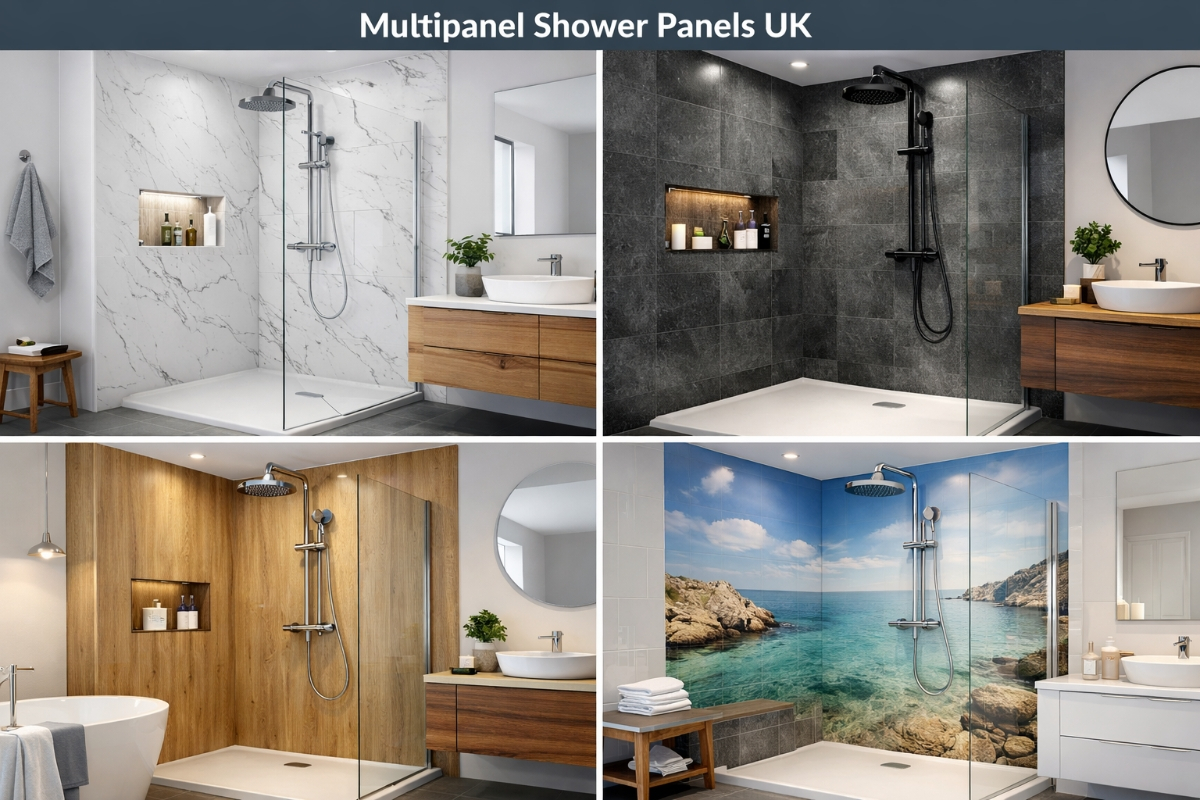
The panel surfaces themselves are impermeable. Water cannot penetrate the decorative face or the core of the panel when it is intact. This makes them significantly more water-resistant than traditional tiling, where grout — even when sealed — remains a potential weak point over time.
However, there is an important caveat: the joins, edges, and cut sections must be properly sealed. The most common cause of water ingress with shower panels is inadequate sealing at:
- Internal and external corners
- The base of panels where they meet the shower tray or floor
- Panel-to-panel vertical joins
- Any cut edges exposed during fitting
Multipanel provides compatible trims, corner profiles, and sealants specifically designed for use with their panels. Using these correctly — and applying a continuous bead of silicone sealant behind the panel edges and at all joins — is essential for a watertight installation.
When fitted by a competent installer following the manufacturer’s guidelines, Multipanel shower panels offer excellent, long-lasting waterproofing performance.
How Long Do Multipanel Shower Panels Last?
Multipanel offers a lifetime guarantee on many of their panel ranges for residential use, which speaks to their confidence in the product’s durability.
In practice, the longevity of shower panels depends on several factors:
- Installation quality: Panels installed with proper sealing and fixing will outlast those fitted poorly.
- Maintenance: Regular cleaning with non-abrasive products prevents surface degradation.
- Usage level: A busy family bathroom will show wear sooner than a guest bathroom used occasionally.
- Panel grade and range: Multipanel offers various product tiers. Higher-specification panels generally carry better surface hardness and resistance to impact and moisture.
With reasonable care, most homeowners can expect Multipanel shower panels to remain in excellent condition for 15–25 years or more. The lifetime residential guarantee on select ranges provides additional peace of mind.
Are Multipanel Panels Suitable for Small UK Bathrooms?
Yes — in fact, Multipanel shower panels can be particularly well suited to smaller bathrooms.
Here’s why:
- Seamless look creates the illusion of space: Without grout lines breaking up the wall surface, panels make a bathroom feel larger and less cluttered.
- Light-reflective finishes: Many Multipanel designs feature gloss or semi-gloss finishes that bounce light around the room — ideal for UK bathrooms that often lack natural light.
- Clean lines: The minimal, grid-free aesthetic suits compact contemporary bathrooms very well.
- Easier to fit in confined spaces: Working with large panels is often easier in tight spaces than cutting and laying individual tiles around every fixture.
For small en-suites, compact shower rooms, or narrow bath enclosures, Multipanel shower panels are a practical and visually effective solution.
Can Multipanel Shower Panels Be Used in Wet Rooms?
Yes, Multipanel panels are suitable for wet rooms — but installation in a wet room requires particular attention to waterproofing.
In a wet room, water is directed across the entire floor to a central or linear drain, meaning walls are exposed to water more broadly than in a conventional shower enclosure. To achieve a safe, long-lasting wet room finish with Multipanel panels, you should:
- Apply a full tanking membrane to the floor and lower walls before fitting panels
- Ensure all panel joins and edges are sealed with appropriate silicone
- Use Multipanel’s dedicated trims and profiles at all corners and junctions
- Consider specifying the higher-specification Multipanel ranges designed for more demanding wet environments
When installed in conjunction with a properly tanked substrate, Multipanel shower panels perform very well in wet rooms and are a popular choice among UK bathroom installers for this application.
Design Options and Styles Available in Multipanel Shower Panels
One of the most compelling reasons for the growing popularity of Multipanel shower panels is the breadth of design options available. The range has expanded considerably in recent years, moving well beyond the plain white panels of early iterations.
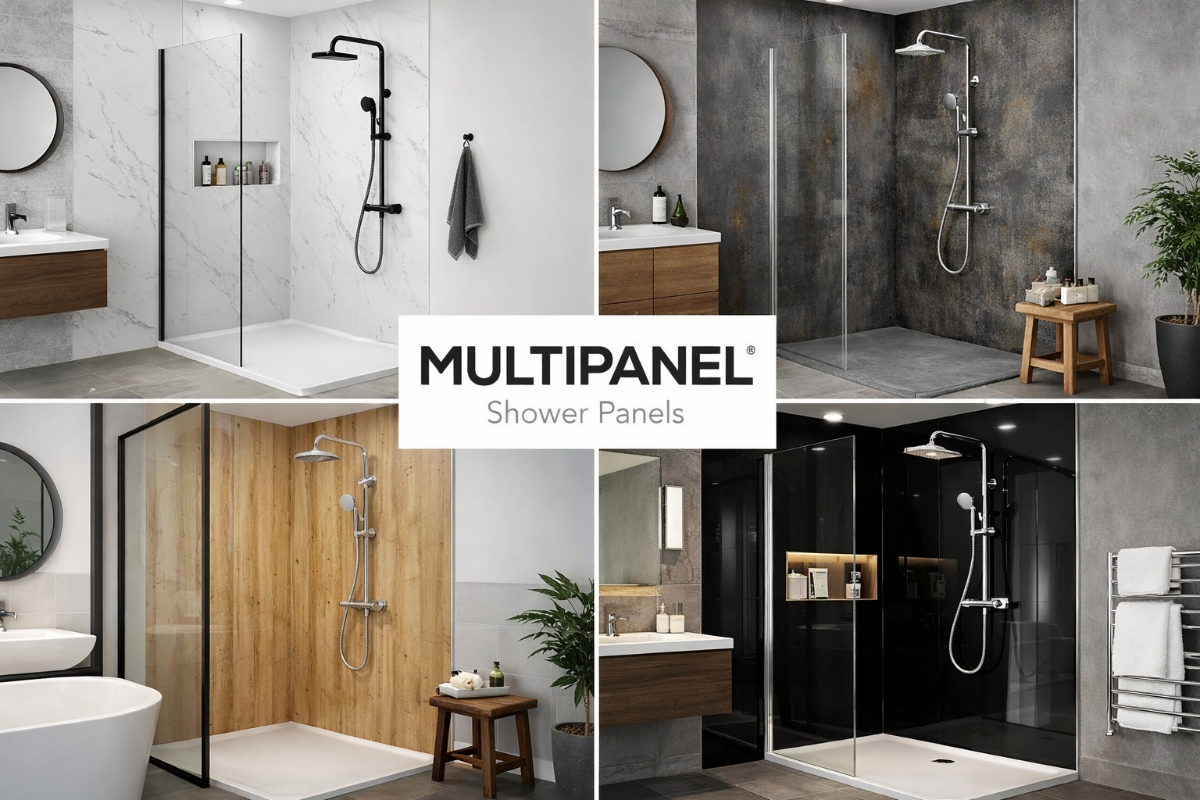
Current design categories include:
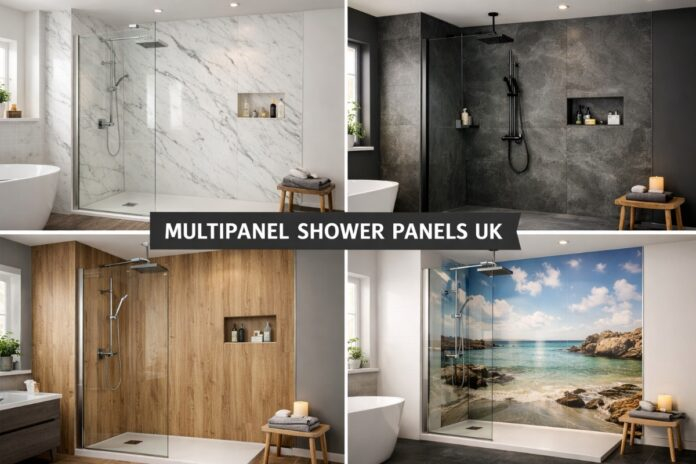
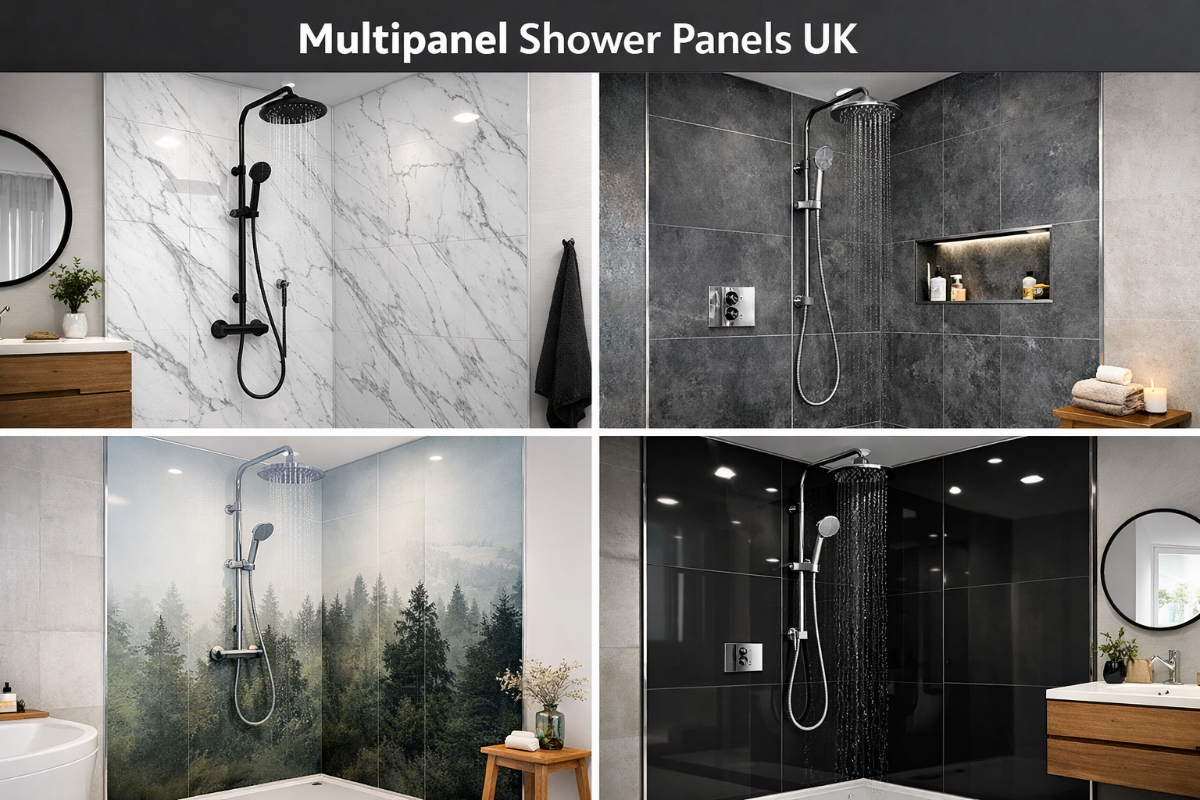
- Stone and marble effects: Realistic reproductions of Carrara marble, travertine, slate, and other natural stones — without the cost or weight of real stone.
- Concrete and industrial finishes: Popular in contemporary and urban-inspired bathroom designs.
- Tile-effect panels: Designs that convincingly replicate the look of metro tiles, large-format tiles, or mosaic patterns — with none of the grout.
- Wood and natural textures: Warm, organic finishes suited to Scandi or biophilic design schemes.
- Plain colours: From crisp white to deep anthracite and muted sage greens, plain-colour options suit both bold and understated bathrooms.
- Gloss and matt finishes: Available across multiple ranges to suit different lighting conditions and personal preferences.
Multipanel also offers panels in varying widths, allowing installers and designers to create interesting visual rhythms across a wall by mixing panel widths — a technique that can closely mimic the feel of individually laid tiles.
Conclusion: Are Multipanel Shower Panels a Good Choice for UK Bathrooms?
For the majority of UK homeowners, Multipanel shower panels represent an excellent bathroom solution — particularly if you value low maintenance, quick installation, and a clean, contemporary finish.
They are especially well suited to:
- Bathroom renovations where speed and budget are priorities
- Refurbishment projects where panels can go over existing tiles
- Small bathrooms and en-suites where seamless surfaces help open up the space
- Busy family bathrooms where easy cleaning is a must
- Wet room installations with correct tanking and sealing
They are a less obvious choice if you are fitting a premium, forever bathroom where the maximum longevity and repairability of high-end porcelain tile is your primary goal — though even in that context, the quality of Multipanel’s top-tier ranges is genuinely impressive.
Overall, Multipanel shower panels deliver a practical, attractive, and durable finish that suits the realities of UK bathroom renovation in 2024 and beyond.
Frequently Asked Questions About Multipanel Shower Panels
1. How much do Multipanel shower panels cost in the UK?
Prices vary by range and panel width, but as a general guide, Multipanel panels typically cost between £40 and £150+ per panel, depending on the specification and design. Full bathroom kits covering a standard shower enclosure may cost £300–£700 in materials. This compares favourably to mid-range tiling once installation labour is factored in.
2. Can I install Multipanel shower panels myself?
Yes. Multipanel shower panels are one of the more DIY-friendly bathroom wall solutions available. The installation process involves cutting panels to size, applying adhesive to the wall, fixing the panels, and sealing all joins and edges with silicone and trim profiles. Full installation guides are provided by Multipanel, and many competent DIYers complete the job successfully without professional help. That said, for wet rooms or complex layouts, professional installation is advisable.
3. Can Multipanel shower panels go over existing tiles?
Yes — this is one of their most practical advantages. Multipanel panels can be fixed directly over existing ceramic or porcelain tiles, provided the surface is sound, flat, and free from any loose or hollow tiles. This saves significant time and cost by eliminating the tile removal and re-plastering stages of a bathroom refurbishment.
4. How do you clean Multipanel shower panels?
Multipanel shower panels are very easy to clean. A soft cloth or non-scratch sponge with a mild bathroom cleaner or diluted washing-up liquid is all that is typically needed. Avoid abrasive pads, scouring powders, or bleach-based products, which can dull or damage the surface finish. Regular wiping after use will keep panels looking their best and prevent limescale build-up — a particular concern in hard water areas of England.
5. Are Multipanel shower panels suitable for hard water areas?
Yes. Because Multipanel panels have no grout, there are no porous surfaces for limescale to penetrate and stain. Surface limescale deposits can be removed easily with a mild descaling product. In hard water areas — much of Southern England, the Midlands, and East Anglia — this is a genuine advantage over tiled walls, where limescale in grout lines can be very difficult to remove completely.
6. Do Multipanel shower panels come with a guarantee?
Yes. Multipanel offers a lifetime guarantee on many of their residential panel ranges, covering manufacturing defects. It is important to follow the manufacturer’s installation guidelines to maintain the validity of this guarantee. Commercial and rental applications may be covered by different terms, so it is worth checking the specific range documentation before purchase.
7. What is the difference between Multipanel ranges?
Multipanel offers several product ranges at different price points and specification levels. Entry-level ranges are well suited to budget renovations, while premium ranges such as Multipanel Linda Barker and Multipanel Heritage offer enhanced surface finishes, greater design detail, and higher resistance to impact and moisture. Choosing the right range for your budget and usage level is important to getting the best long-term result.
8. Can Multipanel panels be used around a bath as well as in a shower?
Absolutely. Multipanel shower panels are widely used as bath panel surrounds and bath end panels, as well as in shower enclosures. Using matching panels around both a bath and shower in the same bathroom creates a cohesive, seamless look that is both practical and visually effective.