


Data verified as of March 2026
Introduction about U.S. Immigration Detention
Immigration detention is a civil — not criminal — process in which the U.S. government holds a person while their immigration case moves through the courts or while removal from the country is arranged. People in immigration detention have not necessarily been convicted of any crime; they are held for administrative reasons related to their immigration status. Detention can last days, months, or, in some cases, years.
Understanding your legal rights in this situation is not just important — it can be the difference between release and prolonged confinement, between winning and losing a case. For families on the outside, knowing what steps to take immediately after a loved one is detained is equally critical. This guide explains the core rights that all detained immigrants hold, the legal remedies available to them, and the practical steps families and detainees can take right now.
Overview of the U.S. Immigration Detention System
U.S. Immigration and Customs Enforcement (ICE), an agency within the Department of Homeland Security (DHS), is responsible for apprehending, detaining, and removing (deporting) individuals who are subject to immigration proceedings. ICE’s Enforcement and Removal Operations (ERO) division manages the day-to-day operations of the detention system. People can be placed in ICE custody after a border encounter, following an arrest by local law enforcement, or during an “at-large” interior arrest in a community.
Detention facilities fall into three broad categories: ICE-owned and operated facilities, privately run contract facilities (operated by companies such as the GEO Group and CoreCivic under federal contracts), and local jails that house federal immigration detainees under intergovernmental service agreements (IGSAs) with ICE. Conditions, oversight levels, and applicable standards can vary significantly across these facility types. As of early 2026, the system has expanded at an unprecedented pace. According to TRAC Immigration (February 2026), ICE was holding approximately 68,289 people in detention as of February 7, 2026 — with over 73% of those individuals having no criminal conviction of any kind. Separately, the American Immigration Council (January 2026) reported that the number of people in ICE detention increased by nearly 75% over the course of 2025, and that 2025 was the deadliest year for ICE detention on record.
Key Legal Rights of Detained Immigrants
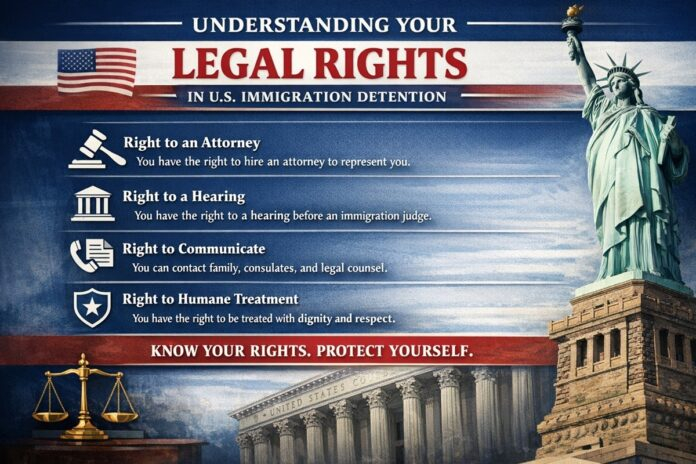
Right to Due Process. The Fifth Amendment to the U.S. Constitution guarantees due process (fair legal procedures) to all persons in the United States, regardless of immigration status. In practice, this means that before a person can be removed from the country, they are entitled to receive a Notice to Appear (NTA) — a document explaining the charges against them — and to have a hearing before an immigration judge (IJ). Detainees also have the right to language access: if a person does not speak English, an interpreter must be provided for court proceedings. Without due process, a removal order can be challenged as legally void.
Right to Legal Representation. Detained immigrants have the right to be represented by an attorney. However, unlike in criminal cases, the government is not required to provide a free lawyer. This distinction is enormously consequential: research by TRAC Immigration has consistently found that detainees who have legal representation are far more likely to be granted bond and to win their cases than those who do not. Detainees must be allowed to contact and meet privately with their attorney, and those communications are protected as privileged — meaning ICE cannot listen in or read the contents. Pro bono (free) legal organizations do exist and are discussed in the Practical Steps section below.
Custody and Bond Redetermination. Many detained immigrants are eligible to request a bond hearing — a proceeding before an immigration judge in which a detainee argues they should be released, either without conditions or after posting a sum of money (called a bond or bail) as a guarantee they will appear for future hearings. The judge considers factors such as flight risk (likelihood of failing to appear), danger to the community, community ties, and family connections. Not everyone is eligible: INA § 236(c) imposes mandatory detention (meaning no bond is available) on certain individuals with specific criminal convictions, regardless of how long ago those convictions occurred. If you are uncertain whether mandatory detention applies to your loved one, consult an experienced Immigration Habeas Corpus Attorney promptly, as the legal landscape around bond eligibility has shifted considerably in recent months and a federal court challenge may be the fastest route to relief.
Protection Against Indefinite Detention. The U.S. Supreme Court held in Zadvydas v. Davis (2001) that the government cannot detain a person indefinitely simply because removal is not possible or is delayed. Once removal is not reasonably foreseeable, continued detention raises serious constitutional concerns. A later decision, Demore v. Kim (2003), confirmed that mandatory detention during a “brief” removal proceeding is generally lawful — but prolonged mandatory detention without any individualized review has been challenged with increasing success in federal courts.
Right to Medical Care and Humane Treatment. ICE detention facilities are required to follow either the Performance-Based National Detention Standards (PBNDS 2011, revised 2016) or the National Detention Standards (NDS 2019), depending on the facility type. These standards address medical care, mental health services, nutrition, sanitation, and safe conditions. Despite these standards, oversight reports — including those from the DHS Office of Inspector General — have repeatedly documented deficiencies in medical care and unsafe conditions at numerous facilities.
Other Core Rights. Detained individuals also have rights to: access to a telephone (including calls to their attorney and consulate); practice of their religion; access to legal reading materials and a law library; interpretation services in interactions with facility staff; and the ability to file internal grievances about mistreatment without fear of retaliation.
Legal Remedies Available
Bond Hearings. If a person is not subject to mandatory detention, they can request a bond hearing. To maximize the chance of success, a detainee should present evidence of strong community ties — U.S. citizen or lawful permanent resident family members, long-term residence, employment history, evidence of no prior criminal history, and letters from community members or religious institutions. An experienced immigration attorney can compile this evidence and argue persuasively before the judge. Based on data compiled by TRAC, having legal representation at a bond hearing increases the likelihood of being granted bond by roughly three times compared to appearing without an attorney.
Appeals and Motions. If a bond hearing results in denial or an unaffordable bond amount, the detainee or their attorney may file a bond appeal with the Board of Immigration Appeals (BIA). Similarly, if a removal order has been entered, parties may file a motion to reconsider (arguing the judge made a legal error) or a motion to reopen (presenting new evidence or changed circumstances). Removal orders can also be appealed to a federal circuit court of appeals.
Habeas Corpus Petitions. Habeas corpus (Latin for “you shall have the body”) is a petition filed directly in federal district court asking a judge to review whether a person’s detention is lawful. This is one of the most powerful tools available to challenging unlawful or prolonged immigration detention. It does not require exhausting immigration court remedies first when the claim is that the government has no legal authority to detain the person at all. Recent federal court data has shown these petitions to be highly effective: according to tracking by the American Immigration Council and the University of Iowa’s Federal Impact Litigation Clinic (February 2026), more than 200 federal judges overseeing over 700 cases have ruled in favor of immigrants who filed habeas petitions, while only eight judges have denied them — a success rate of approximately 97% of decided cases.
What Happens If Rights Are Violated
If a detainee’s rights are being violated — whether through denial of attorney access, medical neglect, unsafe conditions, or failure to provide interpretation — there are several steps to take. First, document everything: write down dates, names of staff involved, specific incidents, and any witnesses. If medical care is being denied, make the request in writing and keep a copy if possible.
Internally, detainees can file a grievance through the facility’s grievance process. Externally, complaints can be filed with the DHS Office for Civil Rights and Civil Liberties (CRCL) and the DHS Office of Inspector General (OIG). Congressional representatives’ offices can also intervene, particularly if there is a risk of imminent removal or harm. When internal remedies are inadequate or exhausted, federal courts may become involved through habeas corpus petitions or civil rights lawsuits. Watchdog organizations such as the ACLU’s Immigrants’ Rights Project and Human Rights Watch have documented systemic violations and pursued litigation against specific facilities.
Recent Data and Trends
The current detention environment is marked by record-high population numbers and a significant reduction in releases. According to the American Immigration Council (February 2026), discretionary releases from ICE detention fell by 87% by the end of November 2025, and as of that same month, approximately 14.3 people were deported directly from detention for every one person released pending a hearing — compared to a roughly 1-to-2 ratio one year earlier. This data reflects a policy shift toward what advocates have described as a “no release” system.
At the same time, litigation is generating wins for detainees. The federal court decision in Maldonado Bautista v. Santacruz (C.D. Cal. 2025) restored bond hearing rights for a large class of immigrants who had entered the country without inspection, overruling a BIA decision that had stripped those rights. As of February 18, 2026, the court issued an additional order — reported by the National Immigration Law Center (February 2026) — after the government was found to be ignoring its earlier ruling. The court also required the government to notify affected detainees in writing, in both English and Spanish, of their right to seek a bond hearing.
Practical Steps for Families and Detainees
If someone is detained, act quickly. Begin by confirming the person’s location using ICE’s free Online Detainee Locator System at locator.ice.gov. You will need the person’s country of birth and either their full name or their ICE “A-number” (Alien Registration Number), which appears on any immigration documents they have received. If the person has been moved to a different facility, the locator system should reflect the updated location, though as the American Immigration Council has noted, the system has become less reliable as the system rapidly expanded in 2025–2026.
- Preserve all documents: Gather passports, visas, entry stamps, any correspondence with USCIS or immigration courts, prior attorney letters, and evidence of residence (lease, utility bills, tax returns).
- Find legal help immediately: Contact nonprofit immigration legal services organizations in the area where the person is detained. Resources include the National Immigration Legal Services Center directory, local bar association pro bono referral lines, and the Vera Institute’s legal representation programs.
- Prepare evidence for a bond hearing: Collect documents showing community ties — birth certificates of U.S. citizen children, letters from employers and community members, proof of long-term residence, evidence of no criminal history, and letters from family members willing to serve as sponsors.
- Set up phone access: ICE detention facilities charge for phone calls, often at high rates. Families can add money to a detainee’s phone account through the facility’s contracted provider. Make sure your loved one has your phone number memorized, not just stored in a phone that may have been confiscated.
- Language assistance: Facilities are required to provide interpretation. If it is not being provided, this can be raised as a grievance and flagged to any legal representative.
Conclusion
Immigration detention is one of the most disorienting and frightening experiences a person and their family can face. But detained individuals are not without rights. The right to due process, to seek release on bond, to challenge unlawful detention in federal court, and to receive medical care and humane treatment are all legally protected — even when those protections are imperfectly enforced. The law is also still evolving: federal courts across the country are actively ruling on bond eligibility and the scope of mandatory detention, creating new opportunities for those who act promptly.
Knowing your rights and moving quickly to assert them — ideally with the help of a qualified immigration attorney — can make a decisive difference in the outcome of a case. Do not wait to seek help, and do not assume that a situation is hopeless without first consulting someone who knows the current state of the law.