

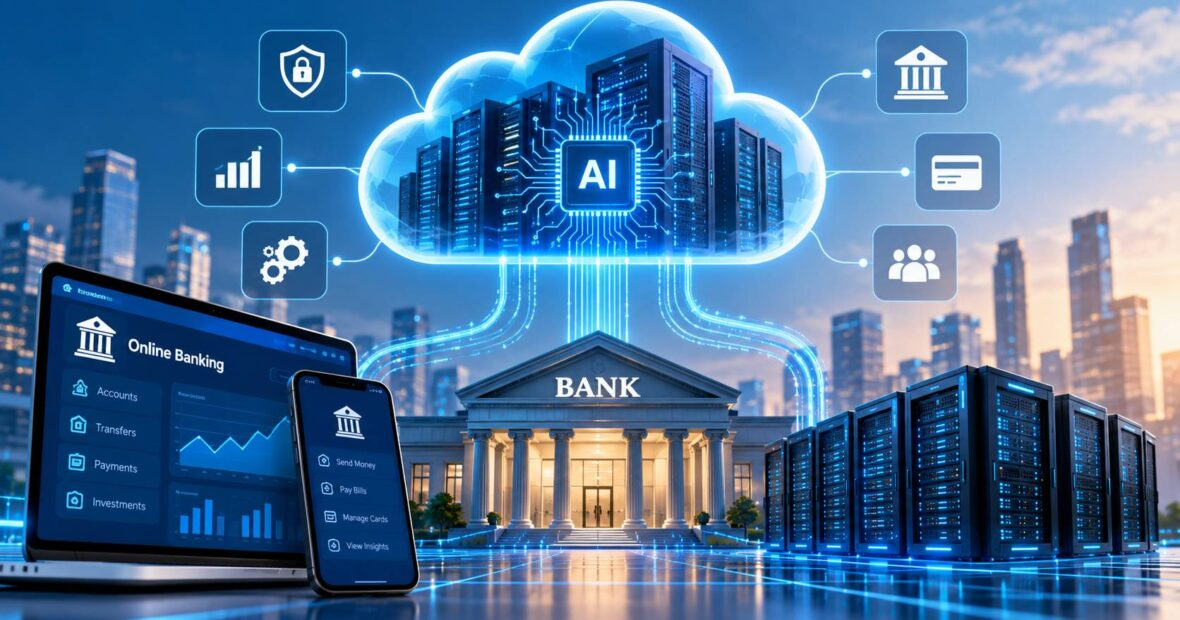
Banking customers now expect the same instant, personal experience they get from consumer apps. They want a mobile assistant that answers questions at 11 p.m., fraud alerts within seconds, faster loan decisions and spending insights that actually help. AI makes this possible, but banks face a tougher path than most industries. Every system must satisfy regulators, protect sensitive financial data and stay online almost all the time.
The right cloud infrastructure for AI in banking connects modern models to core banking systems, payment networks and customer data without breaking compliance or reliability. Many US banks still run core platforms built in COBOL or Java decades ago, which makes AI integration a real engineering challenge. At CRECSO, we help community banks, credit unions, fintechs and larger institutions design AI-ready platforms that meet both customer expectations and regulator scrutiny.
In this guide, you will learn the main AI use cases in banking, the architecture layers that support them, how Bank of America scaled its Erica assistant, common mistakes and a practical roadmap for building cloud infrastructure for AI-powered banking applications.
Where AI Fits in Modern Banking
- Virtual assistants: Answering account questions and guiding customers through tasks.
- Fraud and AML: Spotting suspicious transactions and money laundering patterns.
- Credit decisions: Faster underwriting with more data points.
- Personal finance insights: Spending alerts, savings tips and bill reminders.
- Back-office automation: Document review, KYC checks and dispute handling.
Core Layers of Cloud Infrastructure for AI in Banking
1. Core Banking Integration
APIs and event streams expose account, transaction and customer data from core systems such as Fiserv, FIS, Jack Henry or in-house platforms, without risky direct database access.
2. Secure Data Platform
A governed data lake or warehouse holds transaction history and customer profiles, with strict access controls and data masking.
3. Model Serving and Decisioning
Models run behind APIs with versioning and approval workflows. Federal Reserve guidance on model risk management, known as SR 11-7, expects validation and documentation for models used in decisions.
4. Conversational AI Layer
Assistants combine language models with retrieval from approved knowledge bases and safe actions like moving money between a customer’s own accounts.
5. Security and Resilience
Encryption, hardware security modules, multi-region failover and continuous monitoring keep systems safe and available.
| Option | Strengths | Trade-Offs |
|---|---|---|
| Public cloud | Fast access to AI services and GPUs | Third-party risk management required |
| Private cloud | Maximum control, predictable cost at scale | Large upfront investment |
| Hybrid | Keeps cores private, AI in public cloud | More integration complexity |
AWS describes how many institutions approach these choices on its financial services page. Banks running Java-based systems can also draw on our cloud Java services to modernize integration layers.
Real Business Example: Bank of America’s Erica
Business challenge: Bank of America serves tens of millions of digital banking customers who want fast answers and help at any hour, without long call center waits.
Solution: In 2018, the bank launched Erica, an AI-driven virtual financial assistant inside its mobile app.
Implementation: Erica answers questions, finds transactions, flags duplicate charges and sends proactive insights. Bank of America has also invested heavily in its own private cloud, which it has said saves billions of dollars a year compared with older infrastructure.
Outcome: By 2024, Bank of America reported that Erica had passed 2 billion client interactions since launch.
Business impact: Erica reduced pressure on call centers and became part of daily banking for millions. It shows how a bank can run AI at massive scale on infrastructure it controls closely.
Cost and Compliance Planning
Budget for more than compute. Cloud infrastructure for AI in banking also carries costs for logging, data retention, model validation, penetration testing and vendor reviews. Interagency guidance on third-party risk, issued by US banking regulators in 2023, expects banks to oversee cloud and AI providers throughout the relationship. Build that oversight into the plan from day one rather than treating it as paperwork after launch.
Pros and Cons of Cloud AI for Banks
| Pros | Cons |
|---|---|
| Faster launch of new digital services | Strict regulatory and audit demands |
| Elastic capacity for peak days | Legacy core integration is complex |
| Access to advanced AI and analytics | Vendor concentration risk |
Best Practices
- Build an API layer around core systems before adding AI.
- Follow model risk management practices for every model.
- Restrict AI assistants to approved knowledge and safe actions.
- Run multi-region or multi-zone setups for critical services.
- Review third-party risk for every cloud and AI vendor.
Banks often start with customer-facing assistants, a topic covered on AI for customer service.
Common Mistakes to Avoid
- Letting chatbots give financial advice without guardrails.
- Skipping model validation because a model “only” ranks or sorts.
- Copying sensitive data into many unmanaged systems.
- Ignoring outage plans for AI services customers rely on.
How to Get Started
- Choose one use case, such as a service assistant or document review.
- Map the data, systems and regulatory controls involved.
- Set up secure cloud infrastructure for AI with logging and access controls.
- Validate the model and pilot with a limited customer group.
- Measure resolution rates, errors and complaints before scaling.
Banking AI readiness checklist:
- Core banking APIs available
- Model risk documentation in place
- Third-party risk reviews complete
- Resilience and failover tested
- Customer complaint monitoring live
If your bank is moving workloads from on-premises systems, our cloud migration consulting team can plan the sequence.
Future Trends
Expect AI agents that handle disputes and simple servicing end to end, more real-time payments through FedNow and closer regulatory attention on AI fairness in lending. Cloud infrastructure for AI in banking will increasingly include built-in governance tools.
Key Takeaways
- Banking AI needs core integration, governed data and strong resilience.
- Model risk management applies to AI as much as to classic models.
- Public, private and hybrid cloud can all work with the right controls.
Conclusion
Strong cloud infrastructure for AI lets banks deliver faster, smarter digital services while staying safe and compliant. Core integration, governed data, validated models and resilient design are the foundations. CRECSO helps US banks, credit unions and fintechs build AI-ready banking platforms. Planning your next digital banking feature? Talk to our cloud team.