
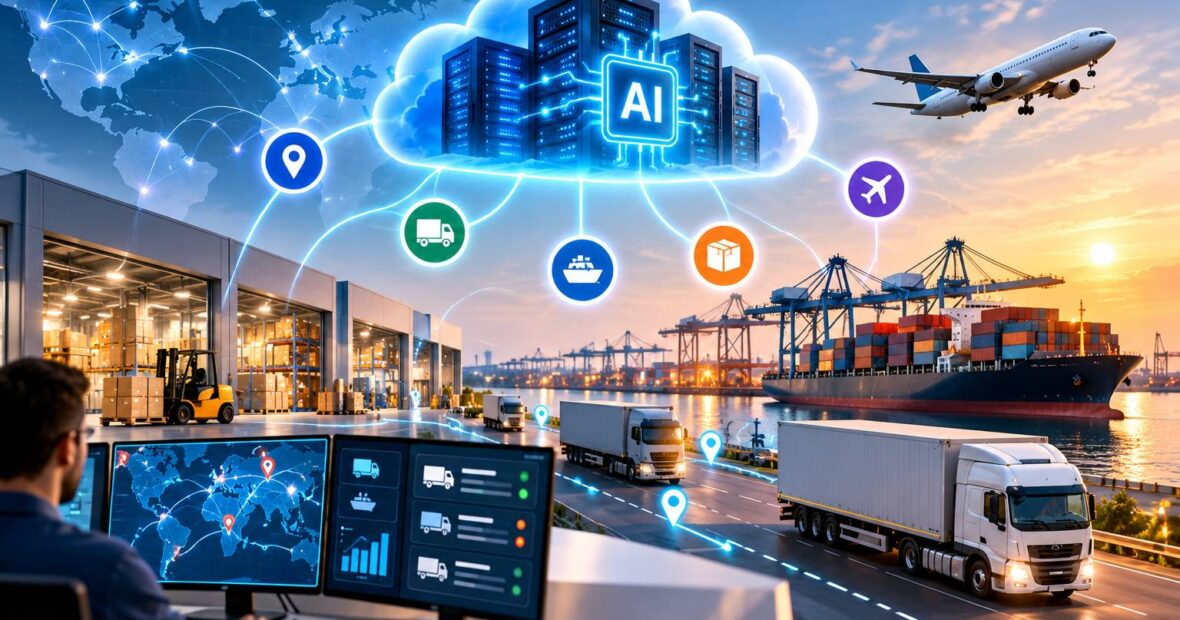
Logistics runs on thin margins and tight timelines. Every extra mile, idle truck, missed delivery window or stockout costs money. Customers now expect accurate delivery estimates down to the hour, and shippers want live visibility from warehouse to doorstep. AI helps by optimizing routes, forecasting demand, predicting delays, balancing warehouse labor and answering “where is my order?” before customers call.
These tools depend on fast, reliable data processing. GPS pings, telematics, scanner events, weather, traffic and order data must flow together in near real time. Building cloud infrastructure for AI-powered logistics software means handling millions of events, solving complex optimization problems quickly and keeping drivers’ apps working on the road.
At CRECSO, we help US carriers, 3PLs, distributors and logistics startups build platforms that turn data into faster, cheaper deliveries.
In this guide, you will learn where AI adds value in logistics, the core architecture layers, how UPS built its ORION routing system, common mistakes and a practical plan for building cloud infrastructure for AI-powered logistics software.
Where AI Creates Value in Logistics
- Route optimization: Planning stops to cut miles, fuel and overtime.
- ETA prediction: Estimating arrival times using traffic, weather and history.
- Demand forecasting: Planning inventory and capacity ahead of peaks.
- Warehouse optimization: Slotting, picking paths and labor planning.
- Exception management: Spotting delays and alerting customers early.
Core Layers of Cloud Infrastructure for AI-Powered Logistics Software
1. Real-Time Event Streaming
Telematics, scans and order updates stream through Kafka or managed services so every system sees the latest status.
2. Geospatial Data Platform
Maps, addresses, geofences and traffic data support routing and ETA models.
3. Optimization and AI Engines
Route solvers and machine learning models run on scalable compute, with GPU options for large problems. Managed services such as AWS Supply Chain also offer forecasting and visibility features that teams can build on.
4. Mobile and Edge Apps
Driver and warehouse apps must work offline and sync when signal returns.
5. Integration Hub
APIs and EDI connect TMS, WMS, ERP, carrier and customer systems.
| Workload | Timing | Compute Pattern |
|---|---|---|
| Nightly route planning | Batch before dispatch | Large burst compute |
| Live re-routing | Seconds | Low-latency services |
| ETA prediction | Continuous | Streaming plus ML models |
| Demand forecasting | Daily or weekly | Batch ML training |
Our logistics software development team builds these systems for carriers and 3PLs.
Real Business Example: UPS ORION
Business challenge: UPS drivers make millions of deliveries a day across the US. Even one extra mile per driver per day adds up to tens of millions of dollars a year.
Solution: UPS developed ORION, short for On-Road Integrated Optimization and Navigation, an advanced route optimization system.
Implementation: After years of development, UPS rolled ORION out across its US driver routes by 2016, combining package data, maps and customer requirements to plan each route.
Outcome: UPS has reported that ORION saves about 100 million miles and 10 million gallons of fuel each year.
Business impact: UPS has estimated annual savings in the hundreds of millions of dollars, along with lower emissions. The program also showed that driver adoption and training matter as much as the algorithm.
Sizing for Peak Season
US parcel volumes surge from Black Friday through late December, and many shippers see a second spike around back-to-school. Route planning that takes ten minutes in July can take an hour in December if compute is fixed. Build cloud infrastructure for AI-powered logistics software so planning jobs can scale out across many servers during peak weeks, then shrink back.
Reserve a modest baseline for steady daily work and use on-demand or spot capacity for the surge. Run a full peak simulation in early fall, using last year’s volumes plus expected growth, so surprises appear in testing rather than on the busiest delivery day of the year.
Pros and Cons of Cloud AI for Logistics
| Pros | Cons |
|---|---|
| Fewer miles and lower fuel costs | Data quality issues hurt accuracy |
| Better ETAs and customer visibility | Many partner systems to integrate |
| Elastic compute for peak season | Driver and staff adoption takes effort |
Best Practices
- Clean and standardize address and location data first.
- Separate nightly planning from live re-routing workloads.
- Design driver apps for offline use.
- Plan capacity for peak season, from Black Friday through the holidays.
- Involve drivers and dispatchers early to build trust.
Supply chain leaders can find broader ideas on AI for supply chain.
Common Mistakes to Avoid
- Ignoring real-world constraints like loading docks and delivery windows.
- Relying on stale traffic or order data.
- Building integrations one partner at a time without a standard hub.
- Sizing compute for average days instead of peak season.
How to Get Started
- Pick one clear problem, such as route planning or ETA accuracy.
- Gather and clean location, order and telematics data.
- Build cloud infrastructure for AI-powered logistics software with streaming, geospatial data and scalable compute.
- Pilot in one region or depot and compare against current results.
- Roll out gradually with driver feedback.
Logistics AI readiness checklist:
- Clean address and location data
- Real-time event streaming live
- Offline-ready driver apps
- Peak season load tested
- Partner integrations standardized
Fleet and warehouse devices often need custom firmware and apps, an area our embedded software development team supports.
Future Trends
Expect AI agents that rebook shipments automatically when delays occur, GPU-accelerated route optimization, autonomous trucks on select corridors and warehouse robots coordinated from the cloud. Cloud infrastructure for AI-powered logistics software will increasingly combine real-time data with simulation.
Key Takeaways
- Logistics AI needs streaming data, geospatial tools and scalable optimization.
- Separate planning and real-time workloads.
- Clean data and user adoption drive real savings.
Conclusion
The right cloud infrastructure for AI-powered logistics software helps companies cut miles, improve ETAs and handle peak seasons without chaos. Streaming data, strong integrations and offline-ready apps turn AI into real savings on the road and in the warehouse. CRECSO helps US logistics companies build AI-ready platforms that scale. Ready to optimize your operations? Talk to our cloud team.