

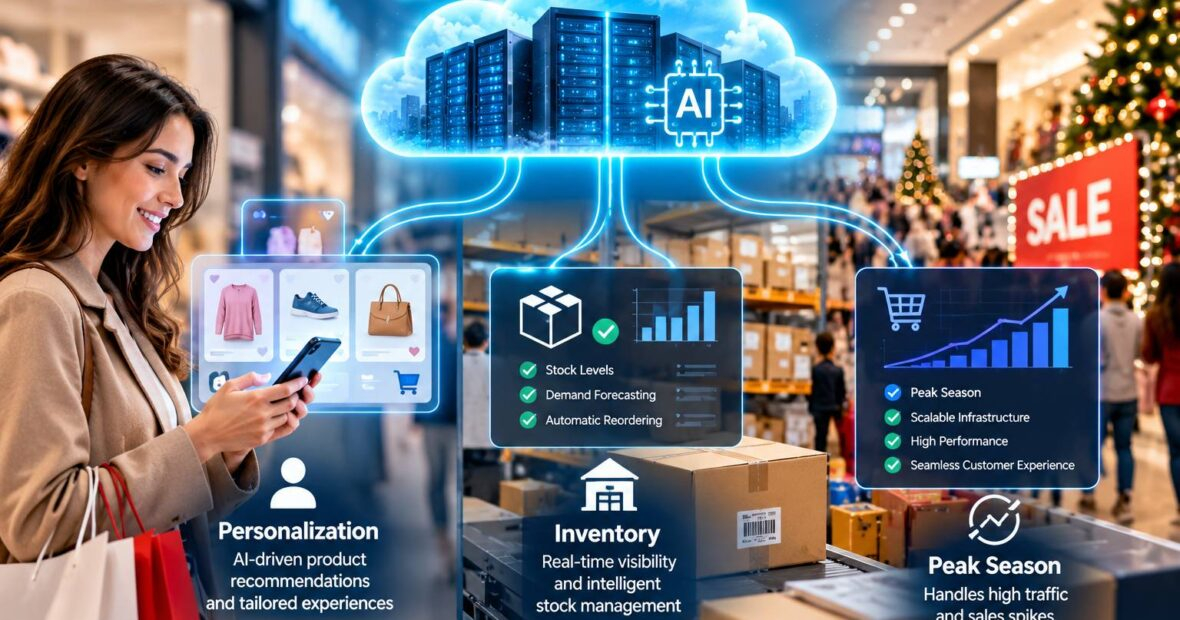
Retail has become a data business. Every search, click, purchase, return and in-store scan tells retailers something about demand. Ecommerce now accounts for roughly 16% of total US retail sales according to the US Census Bureau, and shoppers move freely between apps, websites and stores. AI helps retailers keep up by personalizing recommendations, forecasting demand, setting prices, reducing fraud and answering shopper questions instantly.
All of this depends on infrastructure that can handle huge traffic swings, real-time data and strict security for payments. Black Friday and Cyber Monday can multiply traffic overnight, and a slow product page costs sales. Building cloud infrastructure for AI-powered retail platforms means designing for peaks, keeping data fresh across channels and connecting AI to inventory, pricing and customer systems. At CRECSO, we help US retailers and ecommerce brands build platforms that scale and convert.
In this guide, you will learn where AI adds value in retail, the core architecture layers, how Walmart uses generative AI and hybrid cloud, common mistakes and a practical plan for building cloud infrastructure for AI-powered retail platforms.
Where AI Drives Retail Results
- Personalized recommendations: Showing relevant products across web, app and email.
- Smarter site search: Understanding natural language queries, synonyms and typos.
- Demand forecasting: Stocking the right products in the right stores.
- Dynamic pricing and promotions: Adjusting offers based on demand and competition.
- Shopping assistants: Answering product questions and helping with returns.
- Fraud prevention: Spotting risky orders and return abuse.
Core Layers of Cloud Infrastructure for AI-Powered Retail Platforms
1. Unified Customer and Product Data
A customer data platform and product information system bring together profiles, orders and catalog data from every channel. Without this single view, recommendations in the app may contradict emails or store offers, which confuses shoppers and wastes marketing spend.
2. Real-Time Event Streaming
Clicks, cart events and inventory changes stream into models so recommendations and stock levels stay current.
3. Model Serving at Low Latency
Recommendations and search ranking must return in milliseconds. Caching and regional serving keep pages fast.
4. Forecasting and Planning Workloads
Large batch jobs forecast demand by store and SKU, often nightly, using scalable compute.
5. Elastic Commerce Stack
Storefront, checkout and APIs scale automatically for holiday peaks and flash sales. AWS outlines many of these retail patterns on its retail industry page.
| AI Use Case | Latency Need | Compute Pattern |
|---|---|---|
| Recommendations | Under 100 ms | Cached real-time serving |
| Search ranking | Under 200 ms | Vector and keyword search |
| Demand forecasting | Hours | Batch GPU or CPU jobs |
| Shopping assistant | About 1 second | Hosted language models |
Our retail software development team builds these systems for US brands.
Real Business Example: Walmart
Business challenge: Walmart manages an enormous product catalog across stores and online, and inconsistent product data made search and recommendations less accurate.
Solution: Walmart used generative AI to clean and enrich product information, alongside a hybrid cloud strategy that combines its own data centers with public cloud partners.
Implementation: Models standardized product attributes, descriptions and categories at scale, feeding better data into search and shopping experiences.
Outcome: In 2024, CEO Doug McMillon said generative AI had helped create or improve more than 850 million pieces of catalog data, work that would have needed nearly 100 times the headcount to complete in the same time.
Business impact: Cleaner data improves search, recommendations and conversion. The example shows that AI often pays off first in data quality, which then lifts every customer-facing feature.
Planning for Peak Season
Holiday traffic can be several times normal levels, and AI features must not slow pages down when it matters most. Load test cloud infrastructure for AI-powered retail platforms well before November, pre-warm caches and model servers and set fallbacks so the site shows popular products if a recommendation service lags. Track conversion and page speed together, since a smarter page that loads slowly can still lose the sale.
Pros and Cons of Cloud AI for Retail
| Pros | Cons |
|---|---|
| Higher conversion through personalization | Data spread across many systems |
| Better inventory planning | Peak costs can spike without controls |
| Elastic scaling for holidays | Privacy rules on customer data |
Best Practices
- Fix product and customer data quality before scaling AI.
- Cache recommendations and search results aggressively.
- Build graceful fallbacks for every AI feature.
- Respect privacy laws such as the California Consumer Privacy Act.
- Test AI changes with controlled experiments.
Marketing teams can find related ideas on AI for marketing.
Common Mistakes to Avoid
- Adding AI on top of messy catalog data.
- Letting slow AI calls block page loads.
- Skipping load tests before Black Friday.
- Personalizing without clear consent and privacy controls.
How to Get Started
- Choose one high-impact use case, such as recommendations or search.
- Clean and unify the product and customer data it needs.
- Set up cloud infrastructure for AI-powered retail platforms with streaming, caching and autoscaling.
- Run an A/B test against your current experience.
- Scale to more channels once results are clear.
Retail AI readiness checklist:
- Clean product catalog
- Unified customer profiles
- Low-latency serving and caching
- Peak load test completed
- Privacy and consent controls live
Retailers moving older commerce platforms can use our cloud migration services.
Future Trends
Expect AI shopping agents that compare and buy on a customer’s behalf, more visual and voice search, and store systems that use computer vision for inventory. Cloud infrastructure for AI-powered retail platforms will need to serve both human shoppers and AI agents.
Key Takeaways
- Retail AI depends on clean data, real-time events and fast serving.
- Plan and test for peak season months in advance.
- Data quality improvements often deliver the fastest returns.
Conclusion
The right cloud infrastructure for AI-powered retail platforms helps retailers personalize experiences, stock smarter and stay fast during the busiest days of the year. Clean data, low-latency serving and elastic scaling are the foundations. CRECSO helps US retailers and ecommerce brands build AI-ready platforms that grow with demand. Ready to sell smarter? Talk to our cloud team.