
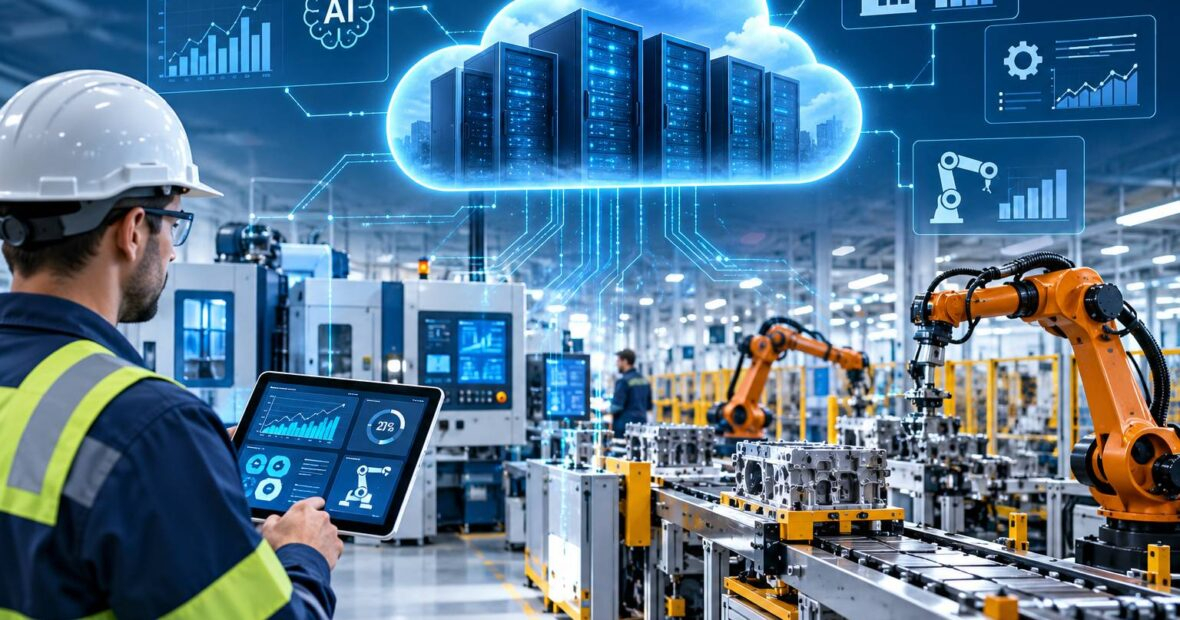
Manufacturing runs on uptime. When a critical machine stops unexpectedly, production lines halt, orders slip and costs pile up fast. Siemens’ 2024 “True Cost of Downtime” report estimated that unplanned downtime costs the world’s 500 largest companies around $1.4 trillion a year, close to 11% of their revenue. AI can help prevent much of that by predicting failures, spotting defects on the line and tuning processes in real time.
To make that work, manufacturers need a reliable path from machines and sensors to analytics and models. Choosing cloud servers for AI-powered manufacturing applications means balancing real-time needs on the shop floor with the scale of the cloud, while protecting operational technology from cyber threats.
At CRECSO, we help US manufacturers and industrial software companies design platforms that connect plants, data and AI without disrupting production.
In this guide, you will learn where AI adds value in manufacturing, how to split work between edge and cloud, how Rolls-Royce uses engine data to predict maintenance, common mistakes and a practical plan for choosing cloud servers for AI-powered manufacturing applications.
Where AI Delivers Value in Manufacturing
- Predictive maintenance: Forecasting equipment failures from vibration, temperature and current data.
- Visual quality inspection: Detecting defects on parts with computer vision.
- Process optimization: Adjusting settings to improve yield and reduce scrap.
- Demand and supply planning: Matching production to orders and materials.
- Energy management: Cutting power use across lines and shifts.
Edge and Cloud: Where Should Manufacturing AI Run?
| Task | Latency Need | Best Location |
|---|---|---|
| Machine safety shutoffs | Milliseconds | PLC or edge device |
| Visual defect detection | Under a second | Edge GPU at the line |
| Predictive maintenance models | Minutes to hours | Cloud servers |
| Model training and fleet analytics | Hours | Cloud GPUs |
Most plants use a hybrid design. Edge devices handle fast, local decisions. The cloud trains models, compares performance across plants and stores long-term history.
Core Architecture on Cloud Servers for AI-Powered Manufacturing Applications
1. Industrial Data Collection
Gateways pull data from PLCs, SCADA and sensors using protocols such as OPC UA and MQTT, then stream it securely to the cloud. Microsoft’s Azure IoT documentation covers common patterns for connecting industrial equipment.
2. Time-Series Storage
Sensor data lands in time-series databases or data lakes built for high-volume readings.
3. Model Training and Deployment
Models are trained in the cloud on GPUs and pushed to edge devices with version control.
4. Integration With MES and ERP
AI insights should trigger work orders, quality holds or schedule changes in existing systems.
5. OT Security
Network segmentation, one-way data flows where possible and strict access control protect production systems.
Our manufacturing software development team builds these connections for US plants.
Real Business Example: Rolls-Royce Engine Health Monitoring
- Business challenge: Rolls-Royce sells aircraft engines under long-term service agreements, where airlines pay for engine availability. Unexpected failures are costly for both sides.
- Solution: Rolls-Royce built engine health monitoring that collects sensor data from engines in flight and analyzes it to predict maintenance needs.
- Implementation: Data flows to cloud analytics, including work with Microsoft Azure announced in 2016, where models compare each engine against fleet patterns and alert engineers to early warning signs.
- Outcome: Maintenance can be planned before problems ground aircraft, and engines spend more time in service.
- Business impact: The data supports Rolls-Royce’s service business model, where revenue depends on availability. It shows how cloud AI can turn equipment data into a recurring revenue stream, not just cost savings.
Sizing Cloud Servers for Manufacturing AI
A single plant can generate millions of sensor readings per hour. Size cloud servers for AI-powered manufacturing applications to hold years of history, since failure patterns can be rare. Use autoscaling compute for model training and batch analytics, and keep inference close to the line. Track data transfer costs, which grow quickly when raw video or high-frequency vibration data moves to the cloud.
Pros and Cons
| Pros | Cons |
|---|---|
| Less unplanned downtime | Legacy machines may lack sensors |
| Fewer defects and less scrap | OT security risks when connecting plants |
| Fleet-wide learning across plants | Data quality varies by line and shift |
Best Practices
- Start with one high-value asset or line.
- Run fast inference at the edge and training in the cloud.
- Segment OT and IT networks carefully.
- Involve maintenance teams in model design and alerts.
- Measure downtime, scrap and maintenance cost before and after.
Operations leaders can find wider ideas on AI for operations.
Common Mistakes to Avoid
- Sending all raw sensor and video data to the cloud.
- Connecting plant networks without security reviews.
- Building models without input from operators.
- Ignoring how alerts reach the people who act on them.
How to Get Started
- Pick a critical asset with known downtime costs.
- Add sensors or gateways where data is missing.
- Set up cloud servers for AI-powered manufacturing applications with secure ingestion and time-series storage.
- Train a first model and test alerts with the maintenance team.
- Expand to more assets and plants once value is proven.
Manufacturing AI checklist:
- Asset and downtime baseline recorded
- Secure gateways and network segmentation
- Edge and cloud roles defined
- MES or CMMS integration planned
- Operator feedback loop in place
Plants with custom controllers or devices can rely on our embedded software development team.
Future Trends
Expect factory digital twins, AI agents that draft maintenance work orders and vision models that learn new defect types from a few examples. Cloud servers for AI-powered manufacturing applications will increasingly work with private 5G and edge GPUs inside plants.
Key Takeaways
- Manufacturing AI needs fast edge decisions and scalable cloud learning.
- OT security and clean sensor data are essential.
- Start small, prove value and expand across lines and plants.
Conclusion
The right cloud servers for AI-powered manufacturing applications help factories reduce downtime, improve quality and learn across every plant. A hybrid edge and cloud design, strong security and close work with operators turn data into results. CRECSO helps US manufacturers build AI-ready industrial platforms. Ready to start your smart factory journey? Talk to our cloud team.