

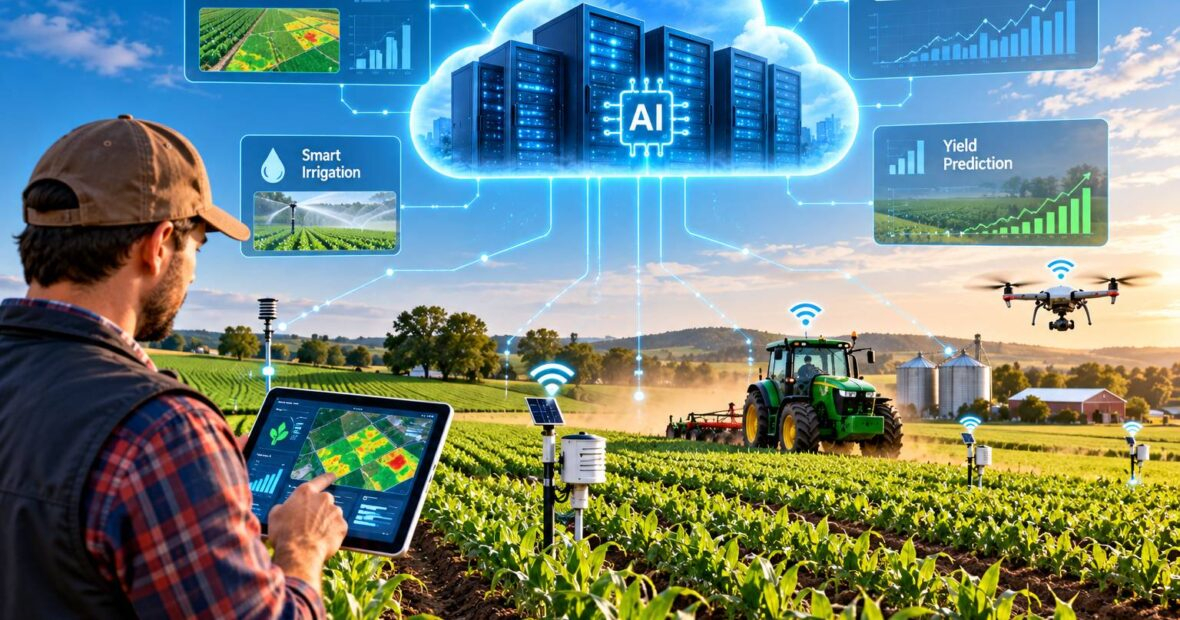
Farming has always depended on weather, soil and timing. Today it also depends on data. Modern tractors, sprayers, drones, soil sensors and satellites produce huge amounts of information every season. AI can turn that data into practical decisions: where to spray, when to irrigate, which fields need attention and how much yield to expect. For US growers facing tight margins, rising input costs and labor shortages, those decisions matter.
Agriculture brings unique infrastructure challenges. Fields often have weak or no connectivity, equipment must make split-second decisions while moving and data volumes spike during planting and harvest. Choosing cloud servers for AI-powered agriculture software means combining powerful edge computing on machines with cloud platforms that store, analyze and learn from every season. At CRECSO, we help agtech companies and farm operations build platforms that work in the field and scale across thousands of acres.
In this guide, you will learn where AI helps farms, how to split work between equipment and the cloud, how John Deere’s See and Spray cut herbicide use, common mistakes and a practical plan for choosing cloud servers for AI-powered agriculture software.
Where AI Helps Modern Farms
- Precision spraying: Targeting weeds instead of whole fields.
- Crop health monitoring: Spotting disease or stress from drone and satellite images.
- Irrigation management: Watering based on soil moisture and forecasts.
- Yield prediction: Planning storage, sales and logistics.
- Livestock monitoring: Tracking health and behavior with sensors and cameras.
Edge and Cloud Roles in Agriculture AI
| Task | Where It Runs | Why |
|---|---|---|
| Weed detection while spraying | On-machine GPUs | Decisions in milliseconds at field speed |
| Field imagery analysis | Cloud GPUs | Large images and heavy models |
| Model training | Cloud | Needs data from many farms and seasons |
| Farm dashboards and planning | Cloud and mobile apps | Access from anywhere |
Rugged edge computers such as NVIDIA Jetson modules let machines run vision models in the field without waiting on a network.
Core Architecture on Cloud Servers for AI-Powered Agriculture Software
1. Store-and-Forward Data Sync
Equipment and sensors store data locally and upload when connectivity is available, often at the end of the day or when machines return to the yard.
2. Geospatial Data Platform
Field boundaries, soil maps, yield maps and imagery are stored with location data for analysis.
3. Image Processing Pipelines
Drone and satellite images are processed on cloud GPUs to produce health maps and alerts.
4. Model Training and Updates
Models trained on many seasons and regions are pushed back to equipment before the next season.
5. Grower Apps and Integrations
Mobile apps, agronomist portals and integrations with equipment and input suppliers bring insights to decision makers.
Our embedded software development team builds the machine and sensor side of these systems.
Real Business Example: John Deere See and Spray
Business challenge: Broadcast spraying covers entire fields with herbicide, even where no weeds grow. That raises costs for growers and increases chemical use.
Solution: John Deere developed See and Spray, which uses cameras and onboard computers on sprayer booms to identify weeds and spray only where needed.
Implementation: Vision models run on the machine at field speed. Application data syncs to John Deere’s cloud-based Operations Center, where growers can review maps and results.
Outcome: Deere reported that in 2024, See and Spray was used on over a million acres with average herbicide savings of around 59%.
Business impact: Lower input costs for farmers and less chemical use show how edge AI and cloud data together create real value in the field.
Sizing Cloud Servers for Agriculture Workloads
Agriculture data is seasonal. Uploads surge during planting, spraying and harvest, then slow sharply in winter. Size cloud servers for AI-powered agriculture software with autoscaling and queues for those peaks, and use lower-cost storage tiers for past seasons. Model training is best scheduled in the off-season, when compute is cheaper and teams have time to review results.
Pros and Cons of Cloud AI for Agriculture
| Pros | Cons |
|---|---|
| Lower input costs and better yields | Limited rural connectivity |
| Insights across fields and seasons | Data ownership concerns for growers |
| Remote monitoring of assets | Hardware costs on equipment |
Best Practices
- Design for offline use first.
- Run time-critical models on the machine.
- Be transparent with growers about data ownership and use.
- Validate models across regions, soils and crops.
- Schedule model training between seasons.
Agribusinesses managing inputs and outputs can find wider ideas on AI for supply chain.
Common Mistakes to Avoid
- Assuming field equipment will always be online.
- Training models on data from one region only.
- Building dashboards growers do not have time to use.
- Ignoring data rights in contracts with growers.
How to Get Started
- Pick one decision, such as irrigation timing or weed control.
- Collect data from sensors, equipment or imagery for that decision.
- Set up cloud servers for AI-powered agriculture software with store-and-forward sync and geospatial storage.
- Pilot on a few fields and compare results with standard practice.
- Expand across acres and crops after a full season of results.
Agriculture AI checklist:
- Offline-first data collection
- Edge compute for real-time tasks
- Geospatial data platform in place
- Grower data agreements clear
- Seasonal capacity plan ready
Agtech startups launching new products can move faster with our MVP development services.
Future Trends
Expect more autonomous tractors, satellite connectivity in remote fields, AI agronomy assistants and carbon tracking tools. Cloud servers for AI-powered agriculture software will increasingly support real-time fleet coordination across large operations.
Key Takeaways
- Agriculture AI needs strong edge computing and seasonal cloud capacity.
- Offline-first design is essential in rural areas.
- Clear data ownership builds grower trust.
Conclusion
The right cloud servers for AI-powered agriculture software connect smart machines in the field with learning and planning in the cloud. Edge processing, offline sync and seasonal scaling make AI practical for real farms. CRECSO helps US agtech companies and farm operations build reliable, data-driven platforms. Ready to put farm data to work? Talk to our cloud team.