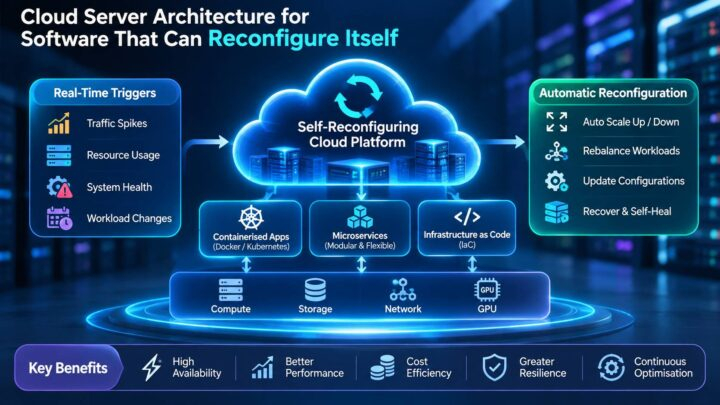

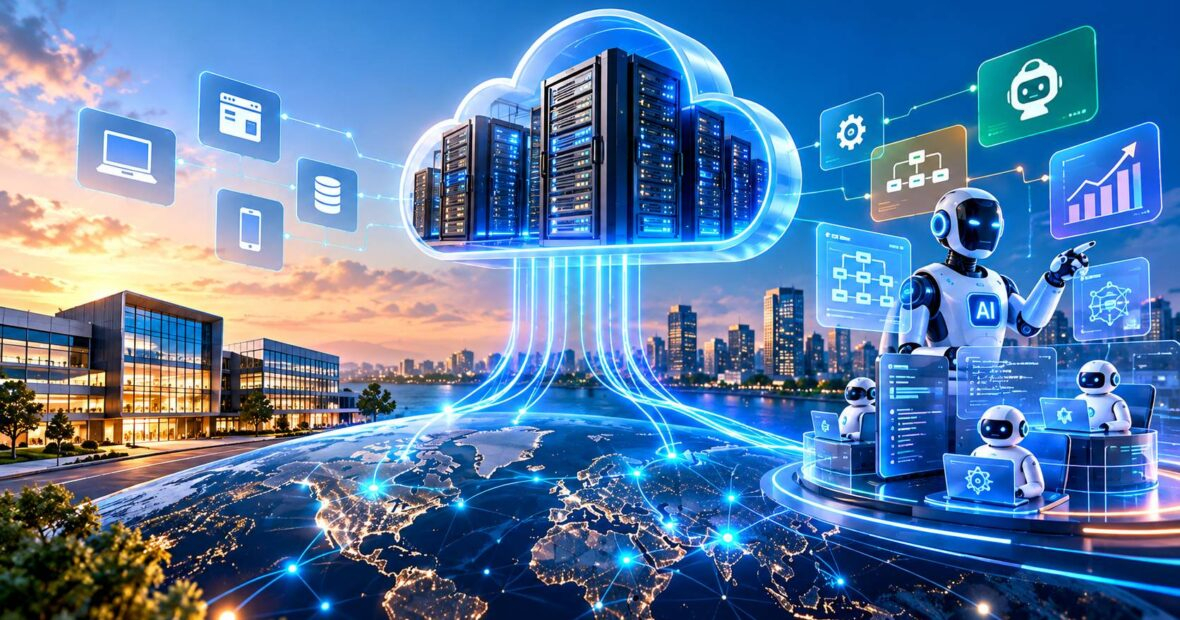
For most of its history, a cloud server had a simple job: host an application written and operated by people. That role is changing fast. Cloud servers increasingly run software that plans, decides and acts on its own: AI agents that resolve customer issues, systems that rebalance supply chains overnight, fleets of robots and vehicles coordinated from data centers and platforms that scale, heal and optimize themselves.
Running this kind of software demands new hardware, new data center designs, new operating models and new forms of oversight. Planning cloud servers for autonomous software is now a strategic question for US business and technology leaders, not just an IT detail.
Energy use shows how big the shift is. Lawrence Berkeley National Laboratory reported in December 2024 that US data centers used about 4.4 percent of the nation’s electricity in 2023 and could use between about 6.7 and 12 percent by 2028, largely because of AI.
At CRECSO, we help US companies plan infrastructure for the next generation of software. In this guide, you will learn how cloud servers are evolving, what autonomous software needs from infrastructure, what xAI’s Colossus cluster shows about the new scale, cost and risk advice, common mistakes and a practical plan to get started.
Three Eras of Cloud Servers
| Era | Main Job | Typical Hardware | Who Operates |
|---|---|---|---|
| Hosting era | Run web apps and databases | General-purpose CPUs | Engineers and admins |
| Cloud-native era | Run microservices and data platforms | CPUs plus managed services | DevOps and SRE teams with automation |
| Autonomous era | Run AI agents and self-managing systems | GPUs, AI accelerators, high-speed networks | Humans setting goals, software acting |
What Autonomous Software Needs From Cloud Servers
- Massive AI compute: GPUs and accelerators for training and continuous inference.
- Fast networks: High-bandwidth links between thousands of chips.
- Persistent runtimes: Environments where agents run for hours or days with memory and state.
- Secure tool access: Controlled connections to business systems and data.
- Strong oversight: Tracing, policy enforcement and human approval for high-risk actions.
- Energy and cooling: Power-dense racks that often need liquid cooling.
How Cloud Servers for Autonomous Software Are Changing
Accelerated Hardware in Cloud Servers for Autonomous Software
AI workloads run on GPUs and custom accelerators rather than CPUs alone. Platforms such as NVIDIA Blackwell pack enormous compute into each rack, which raises power density far beyond traditional servers.
Liquid Cooling and Power
Air cooling struggles with the heat from modern AI racks. Direct-to-chip liquid cooling is becoming common, and data center locations increasingly depend on available power and grid connections.
Agent Runtimes in Cloud Servers for Autonomous Software
Cloud providers now offer managed environments for running agents, with identity, memory, tool gateways and tracing built in. These sit alongside containers and serverless functions as standard building blocks.
Self-Managing Platforms
Infrastructure itself becomes more autonomous, with AI handling capacity planning, failure recovery and cost optimization within human-set policies.
Distributed Footprints
Large training clusters sit in a few power-rich regions, while inference spreads to many regions and the edge to stay close to users and devices.
Governance Layers
Policy engines, audit logs and approval workflows become core infrastructure, because autonomous software must remain accountable to people and regulators.
Real Business Example: xAI Colossus in Memphis
- Business challenge: xAI, the AI company founded by Elon Musk, needed a very large GPU cluster quickly to train its Grok models and compete with established AI labs. Traditional data center projects can take years to plan and build.
- Solution: xAI converted a former industrial facility in Memphis, Tennessee, into the Colossus supercomputer, working with NVIDIA, Dell and Supermicro. The company said the first phase, with about 100,000 NVIDIA GPUs, was brought online in about four months in 2024, and it announced plans to expand the cluster significantly.
- Implementation: The site used liquid-cooled racks, high-speed networking across the GPU cluster and on-site power generation to supplement grid supply while utility upgrades were completed.
- Outcome: Colossus became one of the largest AI training clusters in the world and was used to train xAI’s newer Grok models. The project also drew criticism from local residents and environmental groups over the use of gas turbines and their emissions, leading to permit disputes.
- Business impact: The example shows the new scale and speed of infrastructure behind autonomous software, and its limits. Power, permits, community relations and environmental impact now shape cloud server plans as much as chips do.
What This Means for Most Businesses
Few companies will build their own AI supercomputers. Most will rent capacity from cloud providers, use hosted models and run agents on managed platforms. The practical questions are which workloads need dedicated capacity, how to secure access to scarce GPUs, how to control costs and how to govern software that acts on its own. Planning cloud servers for autonomous software means answering these questions before demand outgrows supply.
Our cloud migration team helps US companies move workloads to platforms ready for AI and autonomous operations.
The Investment Wave
Spending on AI infrastructure has reached historic levels. In January 2025, OpenAI, SoftBank and Oracle announced the Stargate project, with plans for hundreds of billions of dollars in US AI data centers, starting in Abilene, Texas. Microsoft, Amazon, Google and Meta have each guided to tens of billions of dollars in annual capital spending, much of it for AI.
For buyers, this means more capacity over time, but also rapid hardware turnover, shifting prices and long waits for the newest chips in some regions. Plans for cloud servers for autonomous software should stay flexible enough to move between providers and hardware generations.
Security for Autonomous Workloads
When software acts on its own, a compromised agent or model can do real damage at machine speed. Isolate agent runtimes, give each agent its own identity, restrict network access and monitor for unusual behavior. Protect model weights and training data as valuable assets.
Treat prompt injection and data poisoning as serious threats, and test defenses before granting agents more autonomy. Strong security is what makes cloud servers for autonomous software trustworthy enough for critical business work.
Sustainability and Energy
AI’s energy demand is now a board-level issue. Choose regions with cleaner power where latency allows, schedule flexible training jobs when renewable supply is high, use efficient models and measure the carbon footprint of AI workloads. Customers, investors and regulators increasingly ask about these numbers. Efficient design for cloud servers for autonomous software lowers both cost and emissions.
Sizing and Cost Planning
- Inference demand: Forecast agent tasks and model calls as adoption grows.
- Training needs: Decide whether to fine-tune or train models, and how often.
- GPU access: Use reservations or commitments for critical workloads.
- Oversight: Budget for tracing, evaluation and human review.
- Energy: Factor power costs and sustainability goals into region choices.
Track cost per autonomous task and compare it with the human time and errors it replaces. Revisit these figures as model prices fall and new hardware arrives.
Pros and Cons
| Pros | Cons |
|---|---|
| Software that handles more work on its own | Very high compute and energy demand |
| Faster operations and decisions | Scarce and expensive GPU capacity |
| Self-managing infrastructure reduces toil | New governance and accountability needs |
| New products and business models | Community and environmental concerns |
Best Practices
- Separate training, inference and agent runtime planning.
- Secure GPU capacity early for critical workloads.
- Build oversight, tracing and approvals into every autonomous system.
- Place inference close to users and data.
- Measure energy use and choose efficient models.
- Review infrastructure plans every quarter as technology changes.
Executives can review AI for executives for related ideas.
Common Mistakes to Avoid
- Assuming GPU capacity will always be available on demand.
- Letting autonomous software act without oversight.
- Ignoring energy and sustainability in AI plans.
- Building custom infrastructure when managed services would do.
- Planning only for today’s models instead of rapid change.
How to Get Started
- Identify processes where autonomous software could add the most value.
- Estimate compute, data and oversight needs for each.
- Plan cloud servers for autonomous software with the right mix of accelerators, agent runtimes, governance and regions.
- Pilot one autonomous workflow with strong monitoring.
- Scale step by step, reviewing costs, risks and results.
Autonomous software readiness checklist:
- Target processes identified
- Compute and GPU strategy defined
- Agent runtime and tool access designed
- Oversight and approval rules approved
- Energy and region plan in place
- Quarterly review cycle scheduled
Autonomous systems need strong protection, so many companies add managed cloud security across their AI platforms.
Future Trends
Expect AI data centers measured in gigawatts, more custom chips from cloud providers, wider use of liquid cooling and closer ties between data centers and power plants, including nuclear and renewable deals. Agents will manage more business processes and even parts of the infrastructure itself. Cloud servers for autonomous software will become the backbone of how companies operate, with people setting direction and software doing more of the execution.
Key Takeaways
- Cloud servers are shifting from hosting apps to running autonomous software.
- Accelerators, liquid cooling, agent runtimes and governance are the new essentials.
- Power, permits and sustainability now shape infrastructure plans.
- Most businesses will rent this capability and must plan capacity and oversight early.
Conclusion
The future of cloud servers is about running software that thinks and acts, not just hosting applications. Planning cloud servers for autonomous software means combining accelerated hardware, agent runtimes, self-managing platforms, strong governance and responsible energy use. CRECSO helps US companies prepare their infrastructure for this next era. Ready to plan your path to autonomous software? Talk to our cloud team today.