
Energy costs hit every business, from factories and hospitals to office parks and data centers. According to the US Department of Energy, buildings account for about 40% of US energy use and roughly 75% of electricity use.
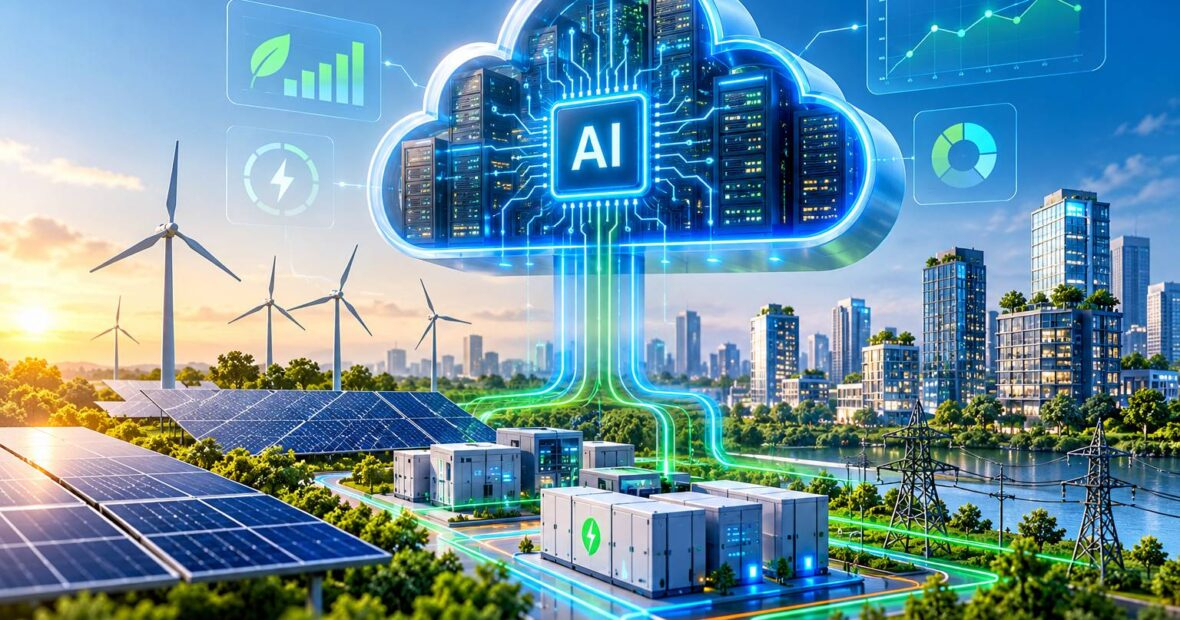
At the same time, utilities are managing more solar, wind, batteries and electric vehicles, which makes supply and demand harder to balance. AI can help by predicting loads, tuning HVAC systems, shifting usage to cheaper hours and spotting waste before it shows up on the bill.
These systems need reliable data flows from meters, sensors and building controls to analytics and models, plus the ability to send safe control signals back. Building cloud infrastructure for AI-powered energy management systems means handling streaming data at scale, protecting critical infrastructure from cyber threats and keeping humans in control of physical equipment.
At CRECSO, we help US energy companies, facility managers and cleantech startups design platforms that save energy without risking operations.
In this guide, you will learn where AI adds value in energy management, the core architecture layers, how Google DeepMind cut data center cooling energy, common mistakes and a practical plan for building cloud infrastructure for AI-powered energy management systems.
Where AI Saves Energy
- HVAC optimization: Adjusting heating and cooling based on occupancy, weather and prices.
- Load forecasting: Predicting demand for buildings, campuses and grids.
- Demand response: Shifting flexible loads when prices or grid stress peak.
- Battery and solar management: Deciding when to store, use or sell power.
- Fault detection: Spotting failing equipment and wasted energy early.
Core Layers of Cloud Infrastructure for AI-Powered Energy Management Systems
1. Device and Meter Connectivity
Smart meters, building automation systems and sensors send data through secure gateways using protocols such as BACnet, Modbus and MQTT.
2. Time-Series Data Platform
High-frequency readings are stored in time-series databases for analysis and model training.
3. Forecasting and Optimization Engines
Models predict loads and prices, while optimization engines choose setpoints and schedules.
4. Safe Control Layer
Recommendations pass through rules and limits before reaching equipment. Local controllers keep running safely if the cloud connection drops.
5. Security and Compliance
Utilities may fall under NERC CIP standards, and all energy systems need strong network segmentation and monitoring.
| Workload | Timing | Where It Runs |
|---|---|---|
| Setpoint control | Seconds | Local controllers and edge |
| Short-term load forecasts | Minutes to hours | Cloud models |
| Demand response planning | Hours to a day | Cloud optimization |
| Model training | Weekly or monthly | Cloud GPUs or CPUs |
Our embedded software development team builds the gateway and controller side of these platforms.
Real Business Example: Google DeepMind Data Center Cooling
- Business challenge: Data centers use large amounts of energy for cooling, and Google’s facilities are among the largest in the world. Tuning cooling systems manually could not keep up with changing conditions.
- Solution: Google DeepMind trained AI models on historical sensor data to predict how cooling changes would affect energy use and temperatures.
- Implementation: The system recommended, and later directly controlled, cooling settings within strict safety limits set by human operators, who could take over at any time.
- Outcome: Google DeepMind reported a 40% reduction in energy used for cooling in its early tests.
- Business impact: The project showed that AI can cut energy costs in complex physical systems, provided safety limits and human oversight are built in from the start.
Sizing Cloud Infrastructure for Energy Data
A large campus can produce millions of readings a day, and a utility far more. Data centers alone used about 4.4% of US electricity in 2023, according to Lawrence Berkeley National Laboratory, and that share is rising with AI. Plan cloud infrastructure for AI-powered energy management systems around steady streaming ingestion, long-term storage for seasonal patterns and burst compute for forecasting before peak periods such as summer heat waves.
Pros and Cons
| Pros | Cons |
|---|---|
| Lower energy bills and emissions | Older building systems may lack data access |
| Better use of solar and batteries | Cybersecurity risk when connecting controls |
| Earlier fault detection | Savings vary by building and climate |
Best Practices
- Start in advisory mode before allowing automatic control.
- Keep local controllers able to run safely without the cloud.
- Set hard limits on temperatures, loads and equipment cycles.
- Segment control networks from corporate IT.
- Measure savings against a weather-adjusted baseline.
Facility and operations leaders can find broader ideas on AI for operations.
Common Mistakes to Avoid
- Letting AI control equipment without safety limits.
- Comparing savings without adjusting for weather.
- Connecting building systems to the internet without security reviews.
- Ignoring occupant comfort in optimization goals.
How to Get Started
- Choose a building, campus or asset with high energy spend.
- Connect meters and building systems through secure gateways.
- Set up cloud infrastructure for AI-powered energy management systems with time-series storage and forecasting.
- Run recommendations in advisory mode for a few months.
- Move to supervised automatic control once results are proven.
Energy AI readiness checklist:
- Meter and sensor data flowing
- Weather-adjusted baseline set
- Safety limits and override in place
- Network segmentation reviewed
- Comfort targets defined
Control systems are attractive targets for attackers, which is why many teams add managed cloud security.
Future Trends
Expect more virtual power plants that combine home batteries and EVs, AI-driven grid forecasting as data center demand grows and stricter building performance standards in US cities. Cloud infrastructure for AI-powered energy management systems will need to coordinate thousands of devices in real time.
Key Takeaways
- Energy AI needs secure device data, forecasting and safe control layers.
- Start in advisory mode and measure against a fair baseline.
- Human oversight and safety limits are essential for physical systems.
Conclusion
The right cloud infrastructure for AI-powered energy management systems helps organizations cut costs, use clean energy better and catch problems early. Secure connectivity, strong forecasting and careful control design make savings real and safe. CRECSO helps US businesses and energy companies build AI-ready energy platforms. Ready to lower your energy costs? Talk to our cloud team.