

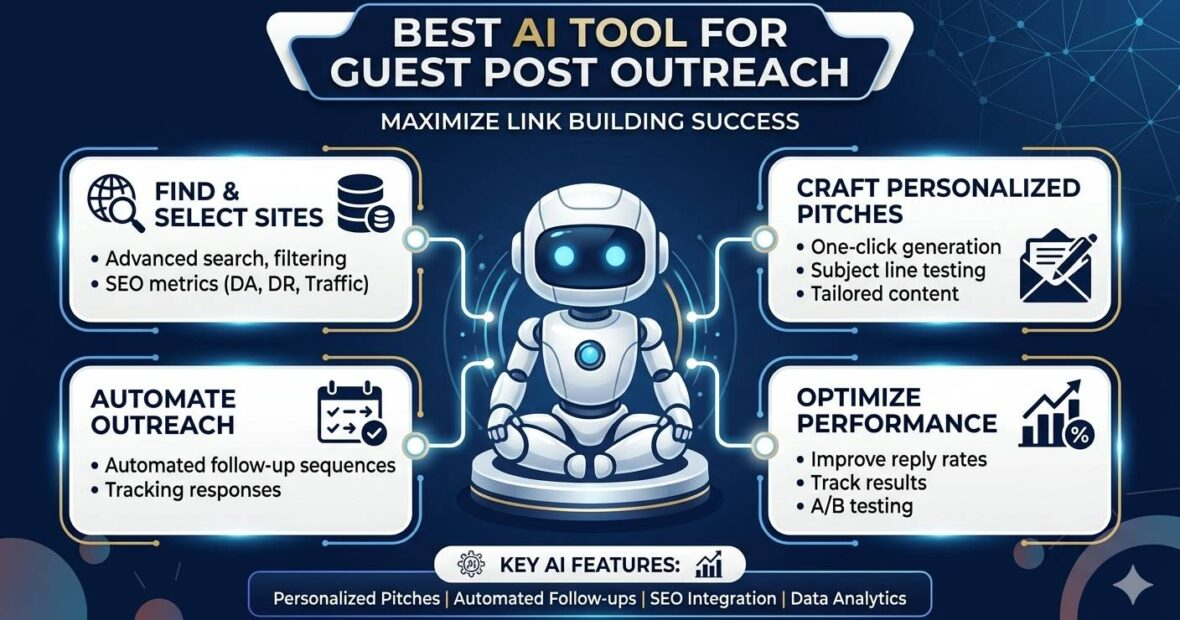
Ask ten link builders which AI tool they use for guest post outreach and you will get ten different answers, and most of them will be correct for the person giving them. That is because “guest post outreach” is not one task. It is a chain of smaller jobs: finding sites worth pitching, learning what they publish, writing a message an editor will actually read, following up, and keeping track of every conversation. No single product handles all of that equally well.
So the useful question is not which tool wins overall. It is which tool fits the part of your process that currently costs you the most time or produces the weakest results. This guide breaks down what AI can realistically do for guest post outreach, the main categories of tools, and how to pick one without wasting a month on the wrong setup.
Where Guest Post Outreach Usually Breaks Down
Most outreach campaigns fail long before the pitch is sent. The prospect list is full of sites that do not accept contributors, the email opens with a compliment that could apply to any blog, and the topic idea overlaps with something the site published last spring. Editors at active publications receive a steady stream of these messages, and they learn to spot a template within a sentence or two.
The time sink is also real. Researching a single site properly (recent articles, topics it avoids, who the editor is, whether there are submission guidelines) can take fifteen minutes or more. Multiply that by fifty prospects and the work becomes the reason campaigns never get finished.
This is where AI earns its place. It is good at compressing research and drafting, and much weaker at judgment. Keeping that distinction in mind will save you from most of the disappointing results people report.
What AI Can and Cannot Do for Outreach
AI is genuinely useful for a handful of tasks:
- Summarizing what a site covers by reading through its recent posts
- Suggesting topic angles that fit a publication’s existing content
- Drafting first versions of pitch emails and follow-ups
- Spotting patterns in which messages get replies
- Cleaning and organizing prospect data
It is less reliable at deciding whether a site is actually worth your time. A tool can tell you a blog publishes marketing content, but it cannot tell you whether the audience matches your client’s customers or whether the editorial standards are ones you want your name next to. It also cannot verify that a site genuinely accepts guest contributions unless a human checks the submission page.
Fully automated outreach, where a tool scrapes sites, writes messages and sends them with no review, tends to produce the generic emails editors ignore. The better approach treats AI as a fast research assistant and first-draft writer, with a person making the final call on who gets contacted and what gets sent.
The Main Types of AI Tools Used in Guest Post Outreach
Rather than naming a single product, it helps to look at the categories, because each solves a different problem.
Prospecting and research tools
These tools help you build the list. Some use search data and site metrics to surface publications in a niche, while newer ones use language models to read a site and describe its topics, tone and recent coverage. If your bottleneck is finding relevant sites, this is the category to focus on. Look for tools that let you filter by topic and let you export data cleanly, since you will probably move the list into another system.
Writing and personalization assistants
General-purpose AI writing assistants can draft a pitch if you give them real context: the target site, two or three of its recent articles, your proposed topic and a short description of your credentials. The output is only as good as that input. A prompt that says “write a guest post pitch for a marketing blog” returns something generic. A prompt that includes specifics returns something an editor might actually answer.
Some outreach platforms build this step in, pulling details from a prospect’s website and inserting them into a draft. These can save time, though it is worth reading a sample of the output before sending in bulk. Personalization that only swaps in the site name and the editor’s first name is not personalization.
Outreach platforms with sequencing and tracking
This category handles the logistics: sending from your mailbox, scheduling follow-ups, pausing a sequence when someone replies, and keeping a record of every conversation. AI features in these tools usually focus on drafting, subject line suggestions and reply classification (sorting responses into interested, declined or out of office). If you manage outreach for several clients or brands, a system like this prevents the quiet disaster of emailing the same editor twice from two different campaigns.
Finding the right option among many
The number of AI products aimed at outreach has grown quickly, and the differences between them are not always obvious from a landing page. A curated Ai Tools Marketplace can make the comparison easier, since you can look at several tools side by side by use case rather than reading each vendor’s own description. Whatever route you take to build a shortlist, test two or three tools on a small batch of real prospects before committing to a paid plan.
How to Choose the Right AI Tool for Your Situation
A few questions narrow the field faster than any feature comparison.
How many pitches do you send each month? A freelancer sending twenty carefully researched pitches does not need sequencing software. A general-purpose AI assistant and a spreadsheet may be enough. An agency sending hundreds across multiple clients needs tracking and mailbox management.
Where does your time actually go? If research eats most of your hours, prioritize a prospecting tool. If drafting is the slow part, a writing assistant will help more. If you lose track of conversations, you need a tracking system.
How much control do you want over the message? Some tools generate and send with minimal oversight. Others produce drafts for you to edit. For guest posting, where reputation matters and editors often know each other, the second approach is safer.
What does it integrate with? A tool that connects to your email, CRM or project tracker will cost you less time in the long run than one that traps data in its own dashboard.
What happens to your data? If you are pasting client information or unpublished article ideas into an AI product, check how the provider handles that input. Policies differ, and some are stricter than others.
A Realistic Workflow
Here is how the pieces might fit together for a small SaaS company that wants to place articles on industry blogs.
First, a prospecting tool produces a list of around eighty sites in the relevant niche. A person then reviews the list and cuts it to thirty, removing sites with thin content, obvious link-selling pages or no connection to the company’s audience.
Next, an AI assistant reads recent posts from each remaining site and suggests topic gaps. The writer reviews those suggestions, picks one strong idea per site, and discards anything that duplicates existing coverage.
The assistant then drafts each pitch based on the chosen angle, and the writer edits every one, adjusting tone and adding a specific reference that shows the site was actually read. The pitches go out through an outreach platform that handles follow-ups after five to seven days and stops the sequence if the editor replies.
At every stage the AI does the slow work and the person makes the decisions. That division is what separates campaigns that earn replies from campaigns that get flagged as spam.
Your Brand Matters More Than Your Tool
Editors do not only judge the email. They look you up. A pitch from someone with no visible author profile, an inconsistent website and no published work elsewhere has a harder time than one from a contributor with a clear identity and a body of writing. Consistency in voice, visuals and positioning across your site and bylines makes you easier to trust, and AI Tools for Branding can help tighten that up before you start pitching, particularly if your company is young and still shaping how it presents itself.
This is also why the pitch itself should sound like you. Heavy reliance on a model’s default phrasing produces a recognizable cadence, and experienced editors notice it.
Building Your Own Setup
Some teams eventually outgrow off-the-shelf tools. If you have specific needs, such as scoring prospects against your own criteria or feeding outreach results into an internal dashboard, a custom workflow may be worth considering. Startups weighing that option can look at AI Development Platforms for Startups to see what is available for building lightweight, tailored automations without a large engineering investment. For most people, though, a combination of existing tools is faster and cheaper to get running.
Common Mistakes to Avoid
Sending at volume before testing is the most frequent one. A campaign of five hundred poor pitches damages your sender reputation and burns sites you might have wanted later. Start with a small batch, read the replies, and adjust.
Another is trusting AI-generated claims about a site without checking them. Language models can describe a publication’s focus inaccurately, and they can state things about submission policies that are simply wrong. Always confirm on the site itself.
Finally, many people judge a tool by how fast it writes rather than by how many editors reply. Reply rate and the number of published placements are the numbers that matter.
The Takeaway
There is no universal best AI tool for guest post outreach, but there is a best fit for your workflow. Identify the slowest or weakest stage in your current process, choose a tool that targets that stage, and test it on a small set of real prospects. Keep a person in charge of prospect selection and final edits, track reply rates for a few weeks, and only then decide whether to expand or switch. A modest setup used carefully will outperform an expensive one used on autopilot.