
Most link building plans don’t fail loudly. They fail slowly. A burst of placements lifts a handful of rankings, the budget runs dry or a core update rolls through, and six months later the traffic graph looks the way it did before anyone spent a dollar. The links are still there. They just stopped doing anything.
Guest posting sits right in the middle of this problem. Done carelessly, it produces exactly that kind of short-lived bump, and in the worst cases it creates a pattern search engines are built to ignore. Done with care, it is one of the few link building methods that keeps paying off, because each placement also brings readers, brand exposure, and a real association between your business and the topics you want to be known for.
This piece looks at what separates those two outcomes, and how to build a guest posting program you would still be comfortable with two or three years from now.
What “sustainable” actually means in link building
A sustainable link profile is one that holds its value without constant repair. In practical terms, that comes down to four qualities:
- It survives algorithm changes. Links that look like they were earned for a reason other than ranking rarely become a liability when Google refines how it evaluates links.
- It compounds. Each new link adds to what you already have instead of replacing links that were lost, deindexed, or devalued.
- It sends people, not just signals. A link that brings a few qualified visitors a month has a floor on its value that no update can take away.
- It fits the business. The sites linking to you make sense for what you sell, who you sell to, and where your customers are.
Notice that none of these depend on volume. A program that produces eight well-placed links a quarter can be more sustainable than one that produces eighty, if those eight meet the criteria above and the eighty don’t.
Where guest posting went wrong, and why it still works
Guest posting earned a bad reputation for good reasons. In the early 2010s, many campaigns meant spinning thin articles, submitting them to any blog that would accept them, and stuffing each one with exact-match anchor text. Google responded by treating that pattern as spam, and plenty of sites paid for it.
What got penalized, though, was the pattern, not the practice. Publications have always run contributed articles from people outside their staff. Trade magazines, industry blogs, and niche publications rely on outside experts because those experts know things their editors don’t. When a practitioner writes something genuinely useful for a relevant audience and the article mentions their company, that is ordinary publishing.
The difference between the two versions is visible in the details: who the publication serves, whether the article would stand on its own without the link, how the link is worded, and how many similar links appear across the web at once.
What Google says about guest posts
Any strategy that claims to be sustainable should start with the rules, so it is worth being plain about them. Google’s spam policies list large-scale article marketing or guest posting campaigns with keyword-rich anchor text links as an example of link spam. Google’s link guidelines also ask that links involving payment or other compensation be qualified with a rel="sponsored" or rel="nofollow" attribute.
Two conclusions follow from that. First, scale plus aggressive anchors is the combination to avoid, full stop. Second, the most durable guest posting programs don’t treat the link as the only thing being bought. They are built so that the placement would still be worth having if it passed no ranking value at all: because it reaches the right readers, puts the brand in front of a relevant audience, and connects the company’s name with a topic in the eyes of both people and search systems.
That second point is the real test. If a placement only makes sense because of the link, it is fragile. If it makes sense for reasons beyond the link, it tends to hold up.
Publisher quality is the foundation
The single biggest factor in whether a guest post lasts is where it lives. A strong article on a weak site inherits the site’s problems. If that site gets hit in an update, sells links to anyone, or quietly drops out of the index, your link goes with it.
Evaluating a publisher well means looking past a single number. Third-party metrics such as Domain Rating (DR) from Ahrefs or Authority Score from Semrush are useful screens, but they are estimates built by tool vendors. Google doesn’t use them. A site can carry a high DR and still have little real readership, especially if that score was inflated with its own questionable links.
A more reliable review asks questions like these:
- Is the organic traffic real, and is it stable? A traffic curve that climbed sharply and then collapsed often points to a site that was penalized or built to sell links.
- Who is the audience? Read a few recent articles. If you can’t tell who the site is written for, readers probably can’t either.
- What else does the site link to? A publication whose recent posts link to casinos, payday lenders, and supplement brands in the same month is selling placements, not publishing.
- Does an editor exist? Sites with real editorial standards push back on weak drafts, request changes, and turn down off-topic pitches. That friction is a good sign.
- Is it a real publication or a network? Private blog networks and expired domains repurposed as blogs are the fastest way to build links that disappear.
This is the ground an authority guest posting service is meant to cover: setting a minimum authority threshold, then confirming traffic, traffic history, relevance, and editorial standards by hand before anyone pitches a single article. At CRECSO, for example, clients approve the list of target sites before outreach begins, which puts the final quality call with the person who knows the business best.
Relevance matters more than raw authority
Consider two placements for a company that sells scheduling software to dental practices. One is on a large general business blog with enormous traffic and a broad audience. The other is on a smaller publication written for practice managers.
The general blog will usually win on metrics. The dental publication will usually win on everything else. Its readers are potential customers. Its topics overlap with the pages you want to rank. The link reinforces what your site is about instead of adding a generic vote from an unrelated corner of the web.
The best programs pursue both, but when forced to choose, relevance is the safer bet. A link profile built on topical relevance looks the way a real company’s link profile should look: most links come from sites in its industry, with a smaller share from broader business and news outlets.
Anchor text and pacing: shaping a natural profile
If publisher quality decides whether each link is sound, anchor text and pacing decide whether the profile as a whole looks natural. This is where many campaigns that choose good sites still go wrong.
Anchor text
When people link to a company on their own, they mostly use its name, its URL, or a plain description of what it offers. Exact-match commercial phrases show up occasionally, but they are the minority. A guest posting campaign that points twenty links at a page with the same keyword-rich anchor leaves an obvious trail.
A healthier mix leans on branded anchors, naked URLs, and descriptive partial-match phrases that fit the sentence around them. The test is simple: read the sentence aloud. If the link wording sounds like something a writer chose for the reader, it is fine. If it sounds like something written for a crawler, rewrite it.
Link velocity
Pacing matters for the same reason. A young site that gains forty links in a month after gaining two per month for a year has a pattern that invites scrutiny, and it rarely lines up with anything happening in the business. Steady, modest growth that roughly tracks a company’s real activity, such as product launches, new research, or seasonal campaigns, is far easier to sustain.
A guest posting link building service that plans around the whole profile, not just the next order, will look at your existing anchor distribution and link history first, then set a monthly pace and anchor mix that fits what is already there.
Point links at pages that deserve them
Another common mistake is sending every guest post link to the homepage, or to whichever page happens to be the current priority, without asking whether that page can hold its position once it gets there.
A link helps a page most when the page already satisfies the searches it targets. If the page is thin, slow, or poorly matched to intent, links may lift it briefly, but visitors will bounce and competitors with better pages will pull ahead again. Fix the page first, then support it.
A practical way to plan this is to map each guest post to a specific page and a specific group of keywords:
- Your core service or product pages, supported by relevant, descriptive anchors from industry publications.
- Long-form guides and original research, which attract links more naturally and pass value to related pages through internal linking.
- Location or category pages, supported by placements from publications that serve those regions or segments.
This kind of mapping is what an SEO guest posting service is built around: each placement is chosen for a keyword and a landing page, so the budget goes where your rankings actually need help and where the page is ready to keep what it earns.
Write articles that earn their place
The article itself is the part most campaigns treat as filler, and it is where a lot of value quietly leaks away. An editor at a good publication can tell within a paragraph whether a draft was written for their readers or written to carry a link.
Articles that hold up over time tend to share a few traits:
- They say something specific. A checklist drawn from real client work, a breakdown of a process with the steps people usually skip, or a clear explanation of a regulation that just changed. Generic “top tips” pieces are the first to be pruned when a publication cleans up its archive.
- The link supports the point. The best links sit where a reader would genuinely want more detail, such as a guide, a tool, or a data source, not wedged into the introduction.
- They match the publication. Tone, length, and depth should fit what the site already publishes.
- They stay accurate. Dated claims, broken sources, and invented statistics can get an article edited or removed later, taking the link with it.
There is also a practical upside. A strong article keeps getting read. It may rank for its own long-tail searches, get shared in newsletters, or be cited by other writers, and each of those creates value that a thin piece never will.
Match placements to where your customers are
For a business selling mainly to American customers, geography is part of relevance. Links from US publications tend to bring US readers, reference US regulations and market conditions, and sit alongside content that American buyers actually read. A profile dominated by placements on sites whose audiences are elsewhere does little for referral traffic and sends a mixed signal about who the business serves.
That doesn’t mean every link has to come from the United States. International coverage is natural for companies with international customers. But the balance should follow the business. If most of your revenue comes from American clients, a guest posting service in the USA that works with publications read by US audiences keeps your link profile aligned with your actual market.
Guest posting at agency scale
Agencies face a different version of the sustainability question. They are running link building for many clients at once, often across unrelated industries, and every placement reflects on the agency’s reputation as well as the client’s.
The risk at scale is sameness. When one vendor supplies placements for twenty clients, the same handful of sites tends to show up over and over, and those sites become less valuable to everyone. Agencies that build lasting programs usually insist on client-specific site lists, per-client anchor planning, and reporting that shows exactly where each link lives.
Confidentiality matters here too. Many agencies need a partner who delivers under the agency’s own brand and never contacts the end client. Guest post services for agencies are typically set up this way, with white-label reporting and NDAs, so the agency keeps the client relationship while the placement work happens behind the scenes.
Measuring what matters
If the only metric you track is rankings for a few head terms, you will miss most of what a sustainable program produces, and you will be tempted to push harder in exactly the ways that make a profile fragile. A fuller scorecard looks something like this:
| Metric | What it tells you | Where to find it |
|---|---|---|
| Live and indexed links | Whether placements are still there and visible to search engines | Periodic manual checks, backlink tools, search operators |
| Referral visits and engagement | Whether the audience is real and relevant | Referral reports in your analytics tool |
| Rankings for target pages | Whether links are supporting the pages they point to | Google Search Console performance report |
| Anchor text distribution | Whether the profile still looks natural as it grows | Anchor reports in Ahrefs or Semrush |
| Branded search volume | Whether exposure is building recognition over time | Search Console queries containing your brand name |
| Leads or sign-ups from referral traffic | Whether placements reach buyers, not just readers | Analytics goals or CRM source tracking |
Give it time. Links often take several weeks to be discovered and several months to show their full effect. Judging a program on its first thirty days tends to reward the wrong behavior.
A simple quarterly rhythm
Sustainable programs tend to run on a steady cadence rather than in bursts. Here is one way a mid-sized B2B company might structure a quarter:
- Weeks 1 and 2: Review the current link profile, anchor mix, and target pages. Confirm the pages being supported are in good shape.
- Weeks 2 and 3: Build and approve a shortlist of relevant publications, with a mix of industry-specific and broader business outlets.
- Weeks 3 to 10: Pitch, write, and publish placements at an even pace, a few per month rather than all at once.
- Weeks 10 to 12: Check that every link is live and indexed, review referral data, and adjust next quarter’s targets and anchor plan.
The exact numbers matter less than the consistency. A company that follows this rhythm for two years ends up with a profile that grew the way a well-known business’s profile usually grows: gradually, from relevant sources, in step with its real activity.
Warning signs worth walking away from
Whether you run guest posting in-house or hire help, a few signals suggest a program is built for a quick result rather than a lasting one:
- Guaranteed rankings or guaranteed results within a fixed number of days.
- A price per link that seems too low for the metrics promised. Real outreach and real writing take time.
- Site lists you are not allowed to see before placements go live.
- Heavy reliance on exact-match anchors, especially when requested by default.
- Large packages delivered in a single week.
- Sites that openly advertise “write for us” alongside price lists and accept any topic.
None of these guarantees a problem on its own, but together they describe the kind of campaign that looks good in a monthly report and poor in a year-over-year one.
The long view
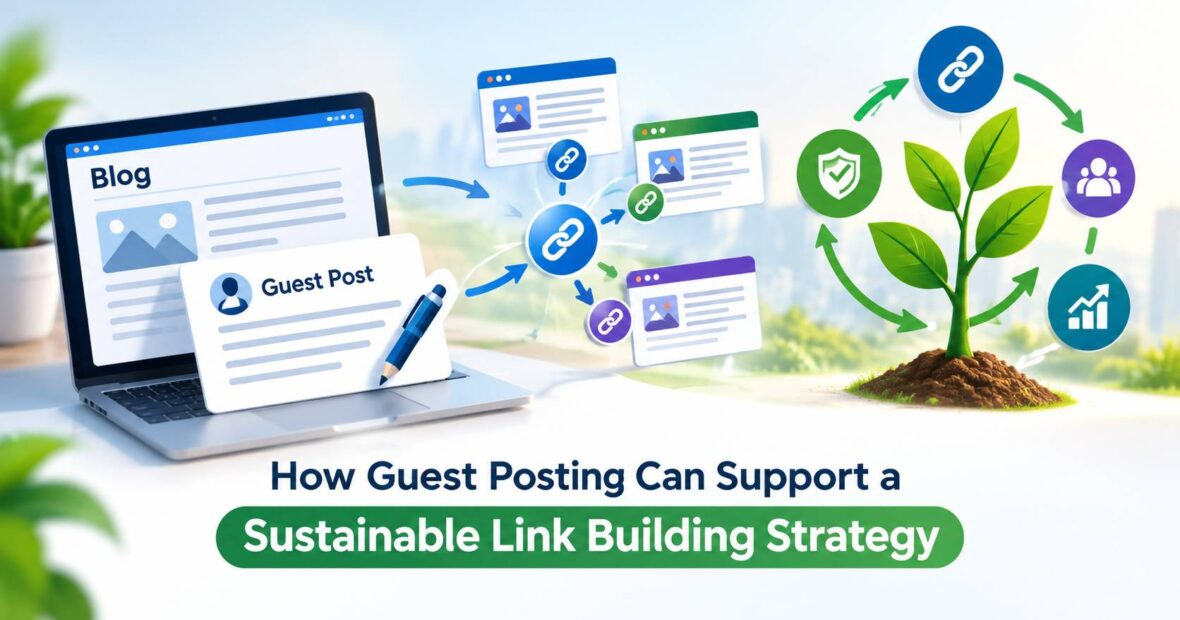
Guest posting supports a sustainable link building strategy when it is treated as publishing first and link acquisition second. That means choosing publications for their readers, writing articles those readers would value anyway, wording links the way a thoughtful writer would, and pacing growth so it matches what the business is actually doing.
None of that is fast, and none of it produces the dramatic month-one charts that aggressive campaigns sometimes do. What it produces instead is a link profile that doesn’t need to be cleaned up, defended, or rebuilt after the next update. For most businesses, that steadiness is worth far more than a short spike.