
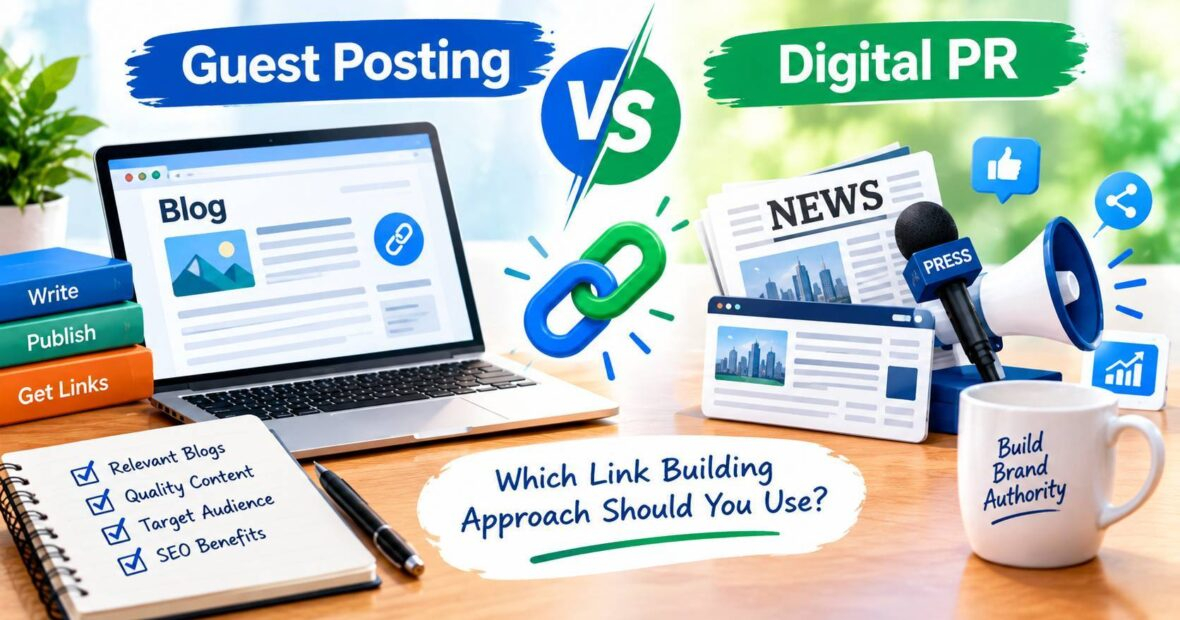
Ask ten SEO teams whether they should invest in guest posting or digital PR, and you will hear some version of the same argument. One side says guest posting is outdated and risky. The other says digital PR is expensive and unpredictable. Both have a point, and both usually miss the more useful question: what is each method actually good at, and what does your site need right now?
The two approaches earn links in different ways, from different kinds of sites, on different timelines. Once you see those differences clearly, the choice stops being a debate and becomes a planning decision. This article walks through how each one works, where each one fits, and how many teams end up using both.
Two ways to earn a mention
At the simplest level, the difference comes down to who writes the content that contains your link.
Guest posting means you, or someone working for you, write an article for another publication. You pitch a topic, the editor accepts it, you deliver a draft that fits their audience, and the published piece includes a link back to your site. You control the topic, the angle, and usually the link placement, within the publication’s editorial rules.
Digital PR means you give journalists and editors a reason to write about you themselves. That reason might be original research, a survey, an interactive tool, a strong expert opinion on breaking news, or a story with genuine public interest. If the angle lands, reporters cover it, and some of that coverage links to your site. You control the asset and the pitch, but not the article, the wording, or whether a link appears at all.
That single distinction, who holds the pen, shapes almost everything else: cost, predictability, link quality, relevance, and risk.
How guest posting works in practice
A typical guest post starts with a list of target publications that serve an audience close to yours. Each one is reviewed for real traffic, topical fit, and editorial standards. Then comes outreach: a short pitch with a few topic ideas matched to what the site already publishes. Once a topic is approved, the article is written, edited to the publication’s guidelines, and published with a link in context.
The strengths are control and relevance. You can choose publications in your exact niche, write about subjects tied to the pages you want to support, and plan links around specific keywords and landing pages. A software company selling to accountants can place articles on accounting publications month after month, building a profile that clearly says what the business is about.
The weaknesses are just as clear. Because the placement is arranged rather than earned through news value, its worth depends heavily on the quality of the site and the article. A poor publisher or a thin draft produces a link that does little and may eventually disappear. And when guest posting is done at scale with keyword-heavy anchors, Google classifies it as link spam in its published spam policies.
How digital PR works in practice
A digital PR campaign starts with an idea that journalists will care about. Common formats include:
- Data studies: original analysis of public data or your own anonymized product data, turned into a clear finding reporters can quote.
- Surveys: polling a defined group, such as small business owners or remote workers, on a question that connects to current news.
- Reactive commentary: offering an expert view quickly when a story breaks, often through journalist request platforms or direct relationships with reporters.
- Tools and visual assets: calculators, maps, or rankings that other writers want to reference.
The campaign is then pitched to reporters whose beats match the story. If it catches on, it can earn links from national news sites, major trade outlets, and regional papers, sometimes dozens from a single idea.
The strengths are reach and credibility. Links from established news organizations are hard to get any other way, and coverage brings brand exposure well beyond the link itself. Because journalists chose to write the story, the links are editorial in the plainest sense.
The weaknesses are predictability and relevance. A well-researched campaign can land zero coverage if a bigger story breaks the same week. Many news sites apply nofollow to outbound links by default, which Google treats as a hint rather than a strong signal. And to get picked up, campaigns often drift toward broad consumer topics, so the links may come from sites loosely connected to what the business actually sells.
Guest posting vs. digital PR at a glance
| Factor | Guest posting | Digital PR |
|---|---|---|
| Who writes the content | You or your team | Journalists and editors |
| Control over link and anchor | High, within editorial rules | Low; the link may not appear at all |
| Topical relevance | Usually high, since you choose niche sites | Varies; broad stories often land on general news sites |
| Typical referring sites | Industry blogs, trade publications, niche magazines | National and regional news, major trade media |
| Predictability | Fairly steady; placements can be planned by month | Uneven; results cluster around successful campaigns |
| Time to first results | Often a few weeks per placement | Weeks to months, including research and asset build |
| Cost structure | Per placement or monthly retainer | Per campaign or retainer; costs are front-loaded |
| Main risk | Low-quality sites and manipulative anchor patterns | Campaigns that earn little or no coverage |
| Best suited for | Supporting specific pages and building topical relevance | Brand visibility and links from high-profile outlets |
Link quality: authority versus relevance
The most common argument for digital PR is that its links are stronger. Often that is true in terms of raw authority. A link from a major newspaper carries weight that a mid-sized industry blog cannot match.
But authority is only half of what makes a link useful. Relevance matters too, and here the picture flips. Suppose a regional insurance broker runs a survey about driving habits and earns coverage on a dozen news sites. Those are good links. Now suppose the same broker places articles on publications read by small business owners and fleet managers, explaining commercial auto coverage in practical terms. Those links sit on sites whose readers might actually buy, next to content that matches the pages the broker wants to rank.
Neither set is better in every way. The news links lift the site’s overall authority and brand recognition. The niche links tell search engines, and readers, exactly what the business does. Strong link profiles tend to have both.
Whichever method you use, publisher quality is the deciding factor for guest posts. Third-party scores such as Ahrefs’ Domain Rating are helpful screens, but Google doesn’t use them, and they can be inflated. Real traffic, a stable traffic history, a clear audience, and working editorial standards say more. That is the job of an authority guest posting service: setting a quality floor and checking each publication by hand before pitching it.
Control, anchors, and link patterns
Control is guest posting’s biggest advantage and its biggest temptation. Because you write the article, you can decide the anchor text and the target page. That makes it easy to support a specific service page, and just as easy to overdo it.
Digital PR produces a naturally varied anchor profile because journalists pick the wording. Most coverage links with the brand name, a plain URL, or a description of the study. That variety is part of why PR links look natural.
Guest posting can match that pattern, but only on purpose. A healthy approach favors branded anchors, naked URLs, and descriptive phrases that read naturally in the sentence, with exact-match commercial anchors used sparingly. Pacing matters too. A steady monthly rhythm looks like a company building its presence. Forty placements in one month looks like a campaign.
A guest posting link building service worth hiring will review your existing anchor distribution and link history before planning new placements, so each month adds to the profile without tipping it out of balance.
Supporting the pages that make money
Here is where the practical difference between the two methods shows up most clearly.
Digital PR campaigns usually link to the campaign asset itself: the study page, the tool, or the report. That page gains authority, and some of it flows to the rest of the site through internal links. But the pages that generate revenue, such as service pages, product pages, and location pages, rarely get linked directly by journalists. Reporters link to data, not sales pages.
Guest posting can fill that gap. An article about choosing a payroll provider can reasonably link to a payroll software comparison page. An article on commercial roofing maintenance can link to a roofing contractor’s service page. The link sits where a reader would genuinely want more detail, and it supports the page the business needs to rank.
This works best when every placement is mapped to a specific keyword and a page that already answers that search well. An SEO guest posting service is built around exactly that mapping, so each link goes to a page ready to hold the ranking it helps earn.
Cost and predictability
Budgets often decide this question before strategy does, so it helps to understand how the money behaves in each model.
Digital PR costs are front-loaded. Research, data collection, design, and pitching happen before any coverage appears. A campaign that lands well can produce many links for that single investment. A campaign that misses produces very little, and the spend is gone. Experienced teams improve their hit rate, but no one can guarantee a journalist will run a story.
Guest posting costs are spread out and closer to linear. Each placement requires outreach, writing, and editing, so the cost per link is more consistent. It rarely produces a sudden wave of links, but it also rarely produces an empty month. For businesses that need to show steady progress to leadership or clients, that predictability has real value.
Neither is cheaper in absolute terms. The better question is which risk you can tolerate: the chance of an expensive campaign that underperforms, or the slower pace of building links one placement at a time.
Geography and audience
Location affects both methods, but in different ways.
Digital PR can target regions by building stories around local data. A study on home energy costs broken down by state, for instance, can earn coverage from local news outlets across the country. That approach works well for brands with national reach.
Guest posting gives more direct control over audience. A business selling mostly to American customers can focus on publications read by US audiences, covering US regulations, market conditions, and buyer concerns. Links from those sites send relevant referral traffic and keep the profile aligned with the market the business actually serves. A guest posting service in the USA focused on American publications makes that alignment easier to maintain, especially for companies whose existing links lean toward other regions.
How agencies decide between them
Agencies face the question across many clients at once, and the answer usually depends on the client’s stage and industry.
A consumer brand with a recognizable name and a marketing budget is a natural fit for digital PR. A B2B software company in a narrow niche, or a local service business, often gets more from steady guest posting in its own industry, because journalists have little reason to cover it and niche publications have every reason to publish useful articles from its experts.
Many agencies run digital PR in-house and outsource guest posting, since the outreach and writing workload grows with every client. When they do, they usually need the work delivered under their own brand, with client-specific site lists and reporting they can pass along directly. Guest post services for agencies are generally set up for this, with white-label reports and confidentiality agreements so the agency keeps the client relationship.
When to choose which
If you need to pick one to start with, these patterns tend to hold:
Guest posting is usually the better starting point when:
- You work in a specialized B2B or professional niche with a clear set of trade publications.
- You need to support specific service, product, or location pages.
- Your budget calls for steady, predictable monthly progress.
- You have subject experts who can contribute useful articles, or a partner who can write to that standard.
Digital PR is usually the better starting point when:
- Your brand or product connects naturally to topics the general public cares about.
- You have access to interesting data, or can collect it.
- Brand awareness is a goal alongside rankings.
- You can absorb the risk of a campaign that doesn’t land.
Using both together
For many businesses, the most effective setup is a combination, with each method covering what the other lacks.
A practical model looks like this. Run one or two digital PR campaigns a year built around original research or a genuinely newsworthy angle. These raise the site’s overall authority and brand visibility. In between, run a steady guest posting program on relevant industry publications, with links mapped to the pages that drive revenue. Then use internal links to move authority from the PR asset pages toward the same commercial pages.
The two also feed each other. Findings from a data study make excellent material for guest articles on trade publications, where the audience is smaller but more relevant. And a history of expert articles in industry media makes your team more credible when pitching journalists. Some teams, including CRECSO, treat guest posting as the steady base of a link program, with PR-style campaigns added when a business has a story worth telling.
Measuring each one fairly
Because the methods work differently, judging them by the same short-term metric is misleading. Counting links per dollar in the first month will usually favor guest posting. Counting total referring domains after a successful campaign will usually favor digital PR.
A fairer comparison looks at a longer window, often six to twelve months, and tracks:
- Links that stay live and indexed, checked periodically rather than once.
- Rankings for the pages each method was meant to support, using Google Search Console.
- Referral traffic and what it does, including sign-ups or inquiries.
- Branded search growth, which often reflects PR coverage.
- Anchor text balance across the whole profile as it grows.
The bottom line
Guest posting and digital PR are not competing answers to the same question. Guest posting gives you control, relevance, and a steady pace, which makes it strong for supporting specific pages and building topical authority in a niche. Digital PR gives you reach and high-profile editorial links, which makes it strong for brand visibility and overall site authority, at the cost of predictability.
The right mix depends on your industry, your budget, and what your site is missing. Start with whichever method matches your most pressing need, measure it over a realistic window, and add the other when the first is running smoothly. Both work best when the content behind them is genuinely useful to the people reading it.